Moon Jellies

Moon Jellies at the Monterey Aquarium

Moon Jellies at the Monterey Aquarium

These alien-looking creatures are named for their translucent, moon like circular bells. They were photographed at the Monterey Bay Aquarium. Although they haven’t gotten to the moon yet, thousands of moon jelly polyps, an early stage in the jelly life cycle, went into orbit aboard the space shuttle. They were part of a study on the effects of weightlessness on development of internal organs in juvenile jellies.

Scientists have studied the life cycle of this jelly extensively. They know the adult male moon jelly releases strands of sperm, which are ingested by female moon jellies. After fertilization, larvae settle on or near the seafloor and grow into polyps. Polyps alternate between feeding and reproductive stages for up to 25 years. In the reproductive phase, polyps launch buds of cloned juveniles, which grow into adults.

Instead of long, trailing tentacles, moon jellies have a short, fine fringe that sweeps food toward the mucous layer on the edges of the bells. Prey is stored in pouches until the oral arms pick it up and begin to digest it. Could I have described more alien specie? As their name alludes they would be more believable as a creature from outer space than something native to Earth.

Comets are astronomical bodies that are roughly shaped like jellyfish. They have a bright bell-shaped head and trail a fainter willowy tail. They can also be as delicate as jellies. The comet ISON, named for its discovering body, the International Space Observation Network will round the sun at perihelion this Thanksgiving Day. If the sun’s gravitational forces don’t tear it apart, then in the days and weeks after Thanksgiving, it could become a wonder to behold. Every day after perihelion it will continue to dim, but with each passing day, as it separates from the sun, it will become easier to view in the predawn sky. By Christmas Day it will become a circumpolar object, meaning; that is, it does not rise nor set but remains above the horizon all night long. The day after Christmas, ISON makes its closest approach to the Earth, some 40 million miles away. It will be a faint object then, about half the diameter of the moon.

Flower Hat Jelly

A Flower Hat Jelly at the Monterey Bay Aquarium

A Flower Hat Jelly at the Monterey Bay Aquarium

Jellies vary from mild to wild. From simple see-through styles to vibrant colors with wild fringe and trim, jellies flaunt an amazing variety of fashions. That hot-pink and lime-green fringe on a Flower Hat jelly is so attractive it helps lure prey. When a curious fish swims over, it gets zapped! Those tentacles grab it for dinner. The Flower Hat jelly is native to the waters around Japan.

Swept Out to Sea

Purple-striped jelly, Medusa de rayas púrpuras, Chrsaora colorata

You know you should be working or at least being more productive than just surfing the web, but you can’t help yourself sometimes. This was true the other morning for a couple of my coworkers. Worker #1 observed, probably on the Drudge Report and promptly began to grumble aloud that Wall Street is seeking $6 billion in FEMA assistance for damages from Hurricane Sandy. Next, doing his best dog imitation, “Oh look a squirrel”, he spied a link to another article about the mystery of the giant eyeball found of the coast of Florida being solved.

Spoiler alert here, the eye belonged to a swordfish. All this commotion drew in Worker #2, who googled “giant eyeball” and corroborated that it once belonged to a swordfish. There must have been a lot of squirrel activity going on in that cube, because a moment later I hear from Worker #2, “This fish looks like Ziggy.”

Worker #2 had found a Christian Science Monitor slideshow entitled, “The 20 weirdest fish in the ocean“. Ziggy is #2. Also, check out #7, a male jaw fish, a known mouth breeder, not to be confused with a mouth breather. At this point I got totally drawn into the discussion, including the recap of how my two coworkers had gotten to where they were. You can call me Worker #3, if you like.

I don’t mean to denigrate either of my coworkers. They are both hard-working guys. This very brief episode was totally the exception. Normally, we labor long hours trying to figure out whether tab A should really go into slot A or maybe it would be better to insert it into slot B. Making paper airplanes can be terribly complicated.

These purple-striped jellies ebb and flow with the currents of their aquarium tank. Summer currents carry the purple-striped jelly into the waters just off of Monterey’s shores. When it arrives, you’d better keep your distance, its sting isn’t fatal, but can be painful.

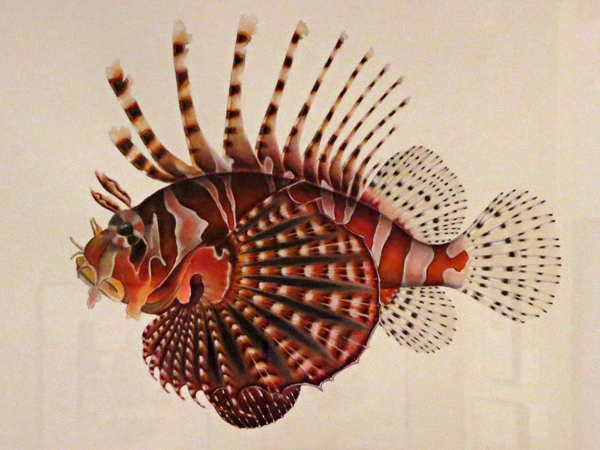
Zebra Lionfish

Zebra Lionfish

Zebra Lionfish, Calene Luczo, Dendrochirus zebra, Watercolor, Pacific Grove Museum of Natural History

This species is a true natural work of art. It is a carnivorous ray-finned fish with venomous spines that is native to the Indian and western Pacific oceans. Now found in the Atlantic Ocean as an invasive species, their population density is increasing at a rapid rate and has become a significant threat to the marine ecology off the East Coast of the United States and in the Caribbean.