Seeing the Light

Muybridge Race Horse Animation

Muybridge Race Horse Animation

Last night, the WashU Science-on-Tap lecture series restarted for 2016. The speaker was Dr. Lihong Wang and his talk was titled, “Compressed Ultrafast Photography”. He is the creator of the world’s fastest 2D receive-only camera that can capture light propagation at light speed, but he started his talk off much more slowly with Eadweard Muybridge’s galloping horse movie. At the Palo Alto racetrack in 1878, Muybridge took eleven cameras, each with a string attached to their shutter and then strung taught across the track. A galloping horse came riding by, firing in sequence each camera’s shot. I’ve downloaded the resulting animated GIF from Wiki. Interestingly, the Wachowski brothers would revisit this photographic technique in their Matrix movies with their so-called “bullet time” effect. Wiki describes this visual effect as detaching the time and space of the viewer from that of the subject. In many ways Dr. Wang ends up doing something similar.

Bullet through Apple, Harold Edgerton, 1964, Smithsonian

Bullet through Apple, Harold Edgerton, 1964, Smithsonian

What exactly does Wang and his team do? They make movies, like Muybridge and Wachowski. Their movies have frame-rate of 30-60 frames-per-second. Wang’s movies refresh between a billion and a trillion times per second. This is fast enough to watch light move across the screen. The speed of light is about 9” per nanosecond. The light source for his movies comes from a laser that is fired for just one trillionth of a second, a picosecond. It looks like a little red blob that in different movies is either reflected or refracted and in a third two blobs race each other, the faster one in air and the slower one in plastic, illustrating the different speeds of light that different media have. In his newest and best movie, he has sped up his game by 1000 times. Here his pulse streaks across the screen and strikes a Phosphorescent screen that then begins to glow. This movie got him the cover article of Nature.

What I find most fascinating about Wang’s research is that he makes these movies with off-the-shelf equipment. His digital camera is similar to the one in your phone. The events that he is photographing occur so quickly that there is no time to get any information off the CCD chip that is your digital camera’s eye. So, the chip’s onboard memory size becomes the major limiting factor to what he can do. He invokes some rather fancy math to help alleviate this limitation. A CCD chip is a 2D array that is designed to record the x and y dimensions of an image. What Wang does is have his CCD record a single x-line of pixels from the image and then use the y-dimension to record the time history of that single x-line. What he gets is a 1D image and its time history. Then in true Muybridge and Wachowski fashion he gangs together a bunch of these CCDs, each one oriented to get a different y-line of the original image and the result is a movie that is traveling at light speed and a career traveling faster.

Alcohol On The Rocks

Pahoehoe Lava

Pahoehoe Lava

Last night, Science on Tap kicked-off its new season. We also used this event as an opportunity to celebrate Joanie’s birthday and watch the Cardinals clinch their latest divisional title. Science on Tap is a collaborative effort between Washington University and in the past Schlafly Bottleworks, but that partnership has become a victim of its own success. We out grew that facility and moved out to the Kirkwood Station Brewery, which boasts a capacity that is four times greater than Schlafly’s. Still, the room was mostly full last night.

The speaker was a geologist, Phil Skewer, an assistant professor. Standing up before the large crowd, he led with a line about being between a rock and a hard place, such is the tenor of his geology jokes. He researches the Earth’s mantle by squishing rocks in his lab. His best line involved a description of the Earth’s density, the average of which is equivalent to that of four Prius stuffed into the volume of a washing machine. Skewer is an experimentalist, who enjoys squishing rocks and then studies how they deform.

After his talk, I asked two questions. First, whether he also uses finite element modeling to study his rock squishing. He was rather dismissive of FEM, “Aw Gawd no!”. I also asked him about studying volcanos, like in Hawaii. I think that this question caught him a little off-guard, because it is so divorced from his own work, professional rock squishing in the lab. I was hoping for something more encouraging, like maybe a post-doc opportunity. 

The accompanying photo shows some pahoehoe lava, from the Hawaiian Kilauea Volcano. The photograph was taken at the Smithsonian’s Natural History Museum. This twisted, ropy surface is typical of pahoehoe (pa-HOY-hoy), a form of basaltic lava. As fluid lava flows downhill, a thin skin on top cools and solidifies. It wrinkles by continued movement of the molten interior.

99 Bottles of Beer on the Wall

Beer Goggles On

Beer Goggles On

Tonight’s agenda was Science on Tap, with beer goggles! Anne was feeling well enough that she went to school today, but she declined to accompany us tonight, because of her cough. She had returned to the original scene of the crime, kindergarten. She felt that a hacking cough during the middle of a lecture might be too distracting to others. Damn the consumptives! Joanie’s friend Vicki joined us though and after the talk, we met with friends, neighbors and bike buddies, Phil and Mary. WashU Psychologist Richard Abrams was the night’s speaker:

His recent research on visual perception has shown that we see things near our hands differently. We focus more intently on objects near the hands, and we process aspects of them uniquely. These changes occur presumably because we can potentially touch them and pick them up. He reviewed research from his lab and others that reveals the special status that the brain gives to objects that are within reach. Taken together, the research shows why you can pick up a bottle of beer (usually) without knocking something over or spilling the beer.

His talk asked the question, “Why is the beer near your hand better than the two across the table?” His following bullets cover his talk’s topics. These bullet items have been shaped to conform to the Bottleworks venue and as such appear somewhat tongue-in-cheek. Analogies aside, his research seems important.

  • You examine it more thoroughly.
  • You are better able to direct mental effort to it.
  • Special mechanisms help you avoid knocking over the other beers.
  • (Unless you are old.)
  • Beer that you can reach looks closer.
  • The beer looks closer if the person next to you can reach it.
  • Imagination may also produce many of these benefits.

A Schlafly representative asked Abrams for a recommendation for reshaping the planform of their six beer flight place mat. After some thought and more dithering he recommended a semicircle over the existing three by two pattern. Originally, it seemed that he was contemplating different patterns for different ages (old and not old), but he decided upon a one size fits all solution. I asked him if he had investigated differences attributable to handedness. He had not. Only after the talk did I think of a follow-up question, “Are you left-handed?”  Anne reminded me of what her Aunt Betty felt about glasses, she always found it easiest to reach for the nearest, fullest glass.

Science On Tap

NASA Galileo's Saturn Eclipse Mosaic

NASA Galileo’s Saturn Eclipse Mosaic

Tonight was another Science on Tap night and like the last one, it was another astronomy talk. The Schlafly Bottleworks hosts these monthly events in conjunction with Washington University. It makes for a nice combination of Schlafly beer and WashU brains. Joanie organized this outing for all of us and her college friend and my current colleague, Pat, made it four of us, along with Anne and I. The speaker was William B McKinnon. His talk was billed to be about our outer solar system.

This event will go on for some time, so, I won’t be able to post anything until much later, after it is over, but I’m sitting here two-hours before the event, just marking time. It is so popular an event that you have to get a seat that early. Did I mention that it is free? So, while I’m sitting here wanting to write, but not being able to write about Science on Tap, because it hasn’t happened yet, let’s change the subject.

Lake Superior or originally Lac Supérieur in French, meant not the best of the Great Lakes, as is so often claimed nowadays, but the uppermost of them. In the French or Spanish manner, lakes are referred to as Lake Something as opposed to the English manner, Something Lake. Lake Superior sounds more impressive than Superior Lake. In modern times, some people have adopted the affected Lake Something convention, because it sounds more cultured.

It’s a Small Solar System
it’s a small Solar System after all
it’s a small, small Solar System

While he was an excellent speaker, I found Bill McKinnon’s talk less than inspiring. I felt that he spent way too much time backfilling planetary astronomy’s ancient history, meanwhile scant attention was paid to what is currently going on. The New Horizons space probe is slated to make closest approach to Pluto this year on Bastille Day. This coincidental date is all that correlates most of McKinnon’s historical prologue to what is really going on now this year. I wanted to know what was happening next, not what has already occurred. I could have read all of what McKinnon said on Wiki. The contrast in quality Science on Tap talks couldn’t have been more stark, than between this talk and the previous Mars rovers Science on Tap.

Mars, Like a Warm Wet Kiss

MOOOOONWALK, part of Cows on Parade, by Craig Wartman

MOOOOONWALK, part of Cows on Parade, by Craig Wartman

Last night, Anne, Joanie and I attended Washington University’s January Science on Tap lecture by its own Professor Raymond E. Arvidson. The title of his talk was Early Mars: Warm, Wet, and Habitable. In his talk, Dr. Arvidson asserted that at one time there was free-flowing water on the surface of Mars and that the conditions for life existed there, like three to four billion years ago, but he was not willing to venture so far as to assert that there was free-flowing beer on the surface of Mars, even if he was giving his talk at the Schlafly Bottleworks, where there was plenty of beer flowing.

There were horrible audio-visual issues, one could either use the microphone of the projector, but not both simultaneously. Arvidson manage to rise above these technical difficulties and carry on. Then there was the issue of the new seating arrangement. The chairs up front were fine, but the long rows of tables, oriented perpendicular to the direction of the speaker meant that half of those people sitting at these tables had to somehow squirm around, in very tight quarters. The geriatric nature of the audiences at these Science on Tap lectures are not very conducive to squirming. I think that orienting the tables, in shorter rows, but parallel to the direction of the speaker, would be better. Also apparently, the fire marshal had taken issue with past overcrowding at these events. A ticketing system was instituted. I don’t think that anyone was turned away, but I cannot be sure. “Other than that Mrs. Lincoln, how was the play?”

It was a great talk, on a subject of keen personal interest. Dr. Arvidson and his team have been and continue to be involved with the myriad of Mars probes, past, present and future. His talk keyed-in on the two still active Mars rovers, Opportunity and Curiosity. Opportunity and its twin Spirit were launched years ago. Both rovers have by now, far exceeded their original warranties. Spirit eventually got stuck in sand and was abandoned in place. Opportunity is still operational, even if it now suffers from both Alzheimer’s and arthritis. After each nightly shutdown, to conserve power, its memory has to be reloaded the next morning. Its mechanical arm has lost enough degrees of motion that it now has to traverse the planet’s surface in what looked like to me as a Hitler salute. The new kid on the block is Curiosity and she is a she. Compared to its predecessors, she is a behemoth. Arvidson was able to tell us what these two still active rovers would be doing that night, today and tomorrow, in great detail. It was a great talk! Plus, the Q&A session after his talk was good too. During this part, Arvidson was able to speculate on Mars projects yet to come.

Life & Death & Early Modern Humans

MEanderthal

MEanderthal

I never made it out of bed this morning, at least not before sunrise, so the painting of Maifest will have to suffice for the celebration of this year’s May Day. Let’s move on. Part of the reason that I was such a sluggard this morning was because Anne and I went out last night. We went to the Schlafly Bottleworks in Maplewood. Now before you all start snickering, hear me out. We were on a noble pursuit, the pursuit of knowledge, the pursuit of knowledge about science. How more noble can you get? I know, I know, there is True Love, but I’ll save the discussion of that for another post.

Schlafly in conjunction with Washington University of Saint Louis sponsors a series called Science-on-Tap, where professors from Washington University come to the Bottleworks and speak about their research. The science is free, but alas the beer is not. This event has become quite the thing and the room was already crowded when we arrived a little on the late side. Fortunately, Joanie had arrived early and saved spaces for the two of us. I really should have bought her a beer for that. Sorry Joan, next time, I promise. Erik Trinkaus, an anthropology professor at Wash U was the night’s speaker. His talk was entitled, “Life and Death among Early Modern Humans”.

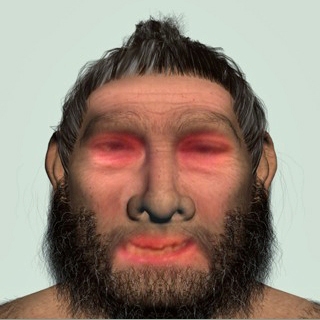
The phrase ‘Early Modern Humans’ implies that these people were physiologically just like us. You clean one of these guys up, buy him some clothes and teach him a few pickup lines and he could be hitting on your sister tonight. The anthropological term for this is that these people displayed behavioral modernity. I’ll leave it to the reader’s sense of incredulousness about this scenario to determine if a club was involved or not. Anyway, nine months from now she could be having a ‘cave’ baby. They were that much like us. The photo with this post is then misleading. It comes from the Smithsonian app, MEanderthal. Joanie took a picture of me and the app took its best guess of what I would look like as a Neanderthal. If you ask me it leaves a lot to be desired both from an authenticity point of view and from its aesthetic appearance.

His talk was about the Red Ochre People of the Mid-Upper Paleolithic period. That would be about 30,000 years ago. After we were home, I googled ‘Red Ochre People’ and a top hit was a Wiki article about Native Americans in the Great Lakes region, about 3,000 years ago. If I had known this during the program’s Q&A, I could have asked a way more intelligent question then the one that I did. No matter their eon though, these individuals are called Red Ochre People, because their remains were splattered with the substance. Evidence of the 30,000 year-old variety of the Red Ochre People can be found across Eurasia, but he keyed on one particular site in Sungir, Russia, which is located several hundred miles north of present day Moscow. Sungir had three well-preserved graves, a 40+ year-old man and two children (10-12). Each individual’s remains were found buried with thousands of mammoth ivory tusk beads. Outside of this site, the most ivory beads found in a Paleolithic burial site were only a few hundred.

So were these beads some form of barter currency? Were these people then rich? These are questions that I wished I had asked. Instead, I asked Trinkaus about DNA testing. They had tried it, but by the time they could, the bones had been out of the ground for almost fifty years and were too heavily contaminated with anthropologist DNA. Anne suspects that the last question asked was a plant. He was asked what he though about a current fad, the Paleolithic Diet. He said, “If you only want to live to be forty and by then have a worn out body, go right ahead.” This got a big laugh from the grey haired audience. He followed up with, “The real Paleolithic Diet was anything they could find that wouldn’t eat them first and wouldn’t poison them if they ate it.” These were stone age hunters and gatherers after all. I am so glad that I didn’t ask him what he thought about the movie “10,000 BC”.