When the Lions Drink

Lion’s Head Mooring Rings

When the lions drink, London will sink
When it’s up to their manes, we’ll go down the drains
When the water is sucked, you can be sure we’re all… [in trouble]

Lining the quay along the River Thames, at regular intervals, in central London are these bronzed lion mooring rings. Originally installed as part of a Victorian sewer project, the legend has since grown that they also act as a flood warning system. Superstitious Londoners have come to believe that the lions keep watch on the Thames. The preceding rhyme describes how to interpret their flooding forecast. Thankfully, the lion’s accuracy has not had to be tested, yet. 

Ripples in Time

Greenwich Paving Stones

I like the way that these stones were laid. Their concentric-intersecting pattern reminds me of ripples on a pond after successive pebbles were thrown into the water, where newer ripples erase older ones as they all continue to arc outwards from their different origins. I can imagine some child, standing on the bank and hurling rocks that send water striders skittering from one tsunami to the next. An imaginary scene that is frozen in time, but captured by these stone’s layout.

Some might call these cobble stones, but Harry, my Father-in-Law would be quick to correct their error. These are cut stones. Their rectangular shape shows that they have been worked. A cobblestone is a rounded unworked stone, such as one plucked out of a stream bed. ‘Paving stone’ ambiguously covers both.

These stones cover a courtyard at the Greenwich observatory, where a metal bar is inlaid that signifies the Prime meridian. I was standing on that bar when I took this picture, so you can think of these ripples of stone as emanating out from it. Looking at this pattern, within that context, the phrase, a ripple in time, comes to mind.  I wonder it that was the artisan’s intent?

Look Right

Look Right

Wandering about London on foot we were frequently greeted with stenciled directions on the pavement telling us to either Look Right or Look Left or sometimes Look Both Ways. These warning signs were placed there in the hope of saving the lives of visiting non-Britons. In London and all of Great Britain people drive on the left, which is the opposite of what the rest of Europe does and what we do in the United States. Truth be told though, there are so many one-way streets and roads are so non-rectilinear that anyone could use these missives, because there frequently was no telling where the traffic was going to be coming from. We observed these warnings and generally didn’t jaywalk, did a lot of walking, had a good time in London and lived to tell the tale.

Ancient Antiquity

Eagle-headed Protective Spirit

The relief to the right portrays an Eagle-headed protective spirit that is Assyrian in origin, from Nimrod, Temple of Ninurta and dates to 860-865 BC. It is carved from gypsum. The temple is located in what is now northern Iraq, but Nimrod was also a place named after a person. Nimrod is mentioned in the Bible as the great-grandson of Noah and he is attributed to be the builder of the Tower of Babel. In other news of ancient antiquity, we both enjoyed a quiet day today. Anne got today off and we puttered around the house, each dedicated to their chosen chores, resulting in domestic domesticity.

St. Mary Axe

The Gherkin

St. Mary Axe is a street in the center of London. It is named for a medieval parish that the street once comprised. The church is gone and the parish later combined with another, St. Andrew Undershaft, which still sits on St. Mary Axe, so all that is left of it is the street name. Today, the most famous building now on the street is nicknamed the ‘Gherkin’, but is officially called 30 St. Mary Axe. This bullet shaped building is a landmark of modern London. The full name of the church was St. Mary, St. Ursula and her 11,000 Virgins. The name is derived from a holy relic held in the church, an axe, one of two that with which the eleven thousand virgins were beheaded. Coincidentally, this history comes to us through a document created during the reign of Henry VIII, who was certainly no stranger to beheading women with an axe. This full name refers to the legend that Saint Ursula, accompanied by eleven thousand handmaidens, who when returning to Britain from a pilgrimage to Rome, had refused to marry a Hunnish chief and was executed along with her whole entourage on the site of modern Cologne, in about 451 AD. Gilbert and Sullivan references St. Mary Axe in their operetta, The Sorcerer and calls it “Simmery Axe”. This reflects the fact that Londoners pronounced the street’s name as “S’M’ry Axe” rather than enunciating it fully.

Figureheads

Figureheads

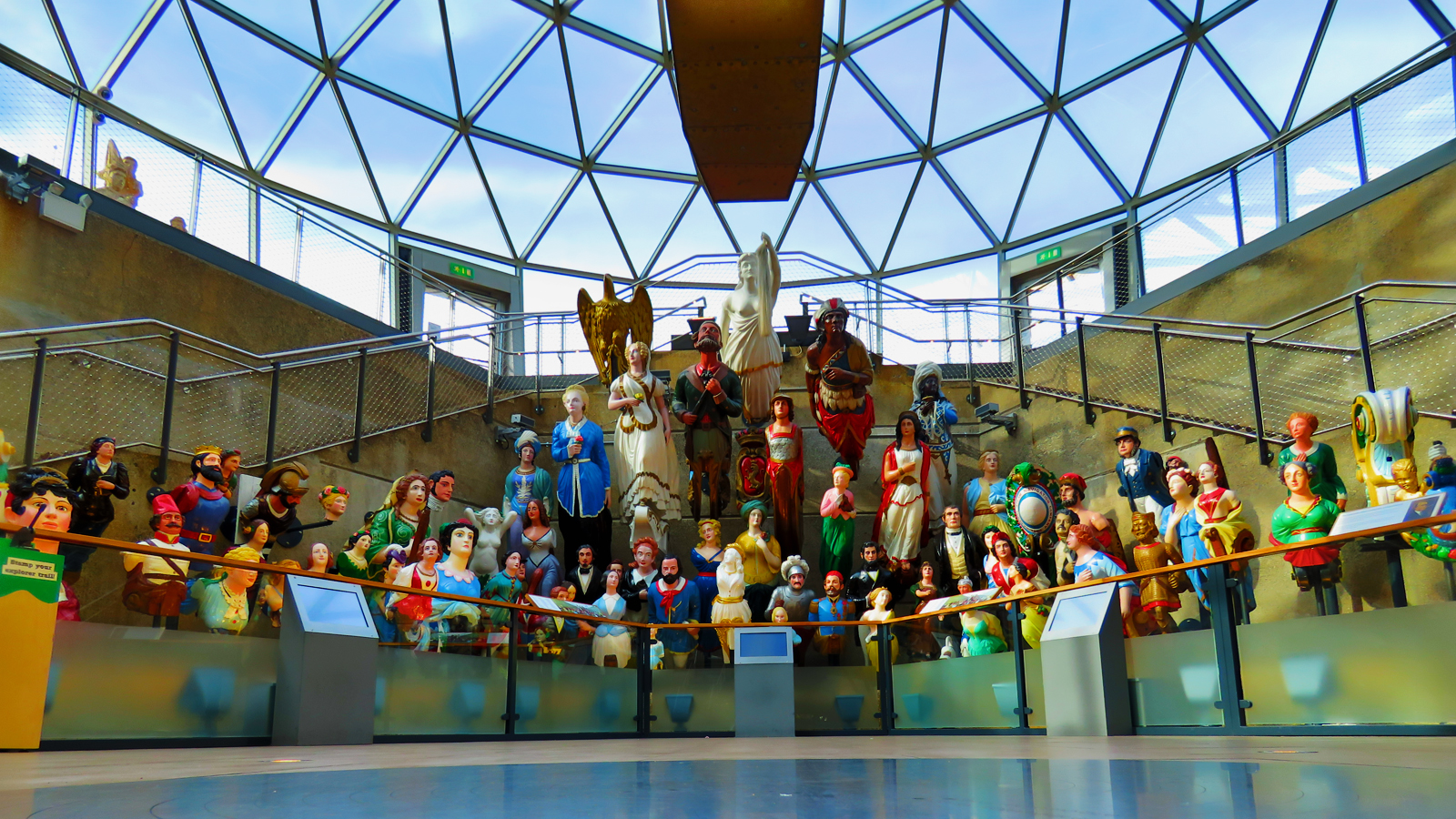
At the Cutty Sark exhibit, just off the ship’s bow is this pictured array of colorful and sometimes playful ship’s figureheads. That is actually the front of the ship’s keel at the center-top of the photo. I crouched below it to take this shot.

Anne has been busy quilting up a storm this last week. She is trying to finish two baby quilts before the end of school, which is only two-weeks away. She hasn’t seem to mind all the rain that we’ve been getting, because that just gives her more time to sew. The weather has been lovely this weekend and I was able to coax her out of the house today. We walked a few blocks to a local art fair, where Anne found a present for someone and also entered a raffle to win up to three more artworks. Good luck!