Documentation

I watched the PBS series on Prohibition this week. Anne watched it too, but sometimes with her eyes closed. Ken Burns, the main documentarian, went to the same high school that Anne and I did. He graduated the year before us. His brother Ric, his collaborator on many films, graduated the year after we did, and my brother Chris and Anne’s sister Jay graduated the year after that. Such is the extent of my connection to this famous family. I liked “Prohibition”, which got me to thinking, what my family’s connection to this period was. Anne’s mother’s family grew up a stone’s throw from the Canadian border, so as children, instead of playing cops and robbers, they played rum runners and revenuers. When the Cabin’s outhouse had to be moved, because it was full, various liquor bottles were found in the hole, but I don’t know if they date back to prohibition. Yes dear friends, there will be no ounce of night soil left unturned in the pursuit of this blog. I asked my Dad, if he had stories about Prohibition or knew any stories that Mom might have told. This is what he had to say:

Yes, your great-grandfather (Mom’s mother’s father) was a lobsterman out of New Bedford. Well, any kind of fishing is hard work so he decided to try his hand at a little bit of rum running. He could see out beyond the three-mile limit ships that were sort of floating supermarkets for booze. They would sell to anyone who could get out there and he had a boat. So out he went, filled the hold of his boat and returned to the pier in New Bedford to unload. Unfortunately, the revenuers got wind of his enterprise and closed in on him.  He spotted them and ran away. He wasn’t arrested, but he lost his boat.

I don’t know any stories about my father’s side of the family but on my mother’s side, in West Virginia, where she was born and grew up moon shining and brewing white lightning came as natural as breathing. These were the same people who caused the whiskey rebellion during George Washington’s administration, so there is a long history there, but I don’t know any specific details.

So, while Anne’s family members were playing rum runners, some of my family members were rum runners. One of Burns’ points was that prohibition touched everyone. I guess that was true. I chose the picture of the Arch for this post, because another great documentarian, Charles Guggenheim, once produced a film about its making. It was nominated for an Academy Award in ‘67 and is still played daily, in the museum, beneath the Arch. Called “Monument to the Dream”, I found this YouTube video of its climatic final minutes, the capstone of the film. If you look closely at my picture of the Arch, you can see a line of rust forming along one of its welds. It is not an isolated flaw and is by no means the worst. The parks service is now studying what should be done to repair this damage. I anxiously await the arrival of whatever Arch crawling caterpillar of a device that is eventually set upon the wall, to expunge the rust from this stainless steel wonder. Wait, did you say stainless? How many ounces of silver could be wrought, if we just melted down the Arch? Does this blog make me a documentarian too, or just a fool on his own little soap box? 

The Pillars of the Earth

The Pillars of the Earth, Ken Follett’s 1989 novel, is an epic, soap operatic, Oprah book club selection of an extravaganza that is really all about building beautiful cathedrals, in 12th century England. No really it is all about blood, sex, rape and murder, or what passed for political discourse back then. Last year it was made into an eight-part, TV miniseries. Anne and I watched this series, via Netflix, and liked it. Anne had plowed through the book, years ago, so that was not too surprising for her, plus it had enough mayhem in it to appeal to me.

In this story all politics is personal. The state is the king, the king is the state and the king is just a man, but not a just man. The story unfolds during a period of English civil war known as the Anarchy. As in the American Civil War, English society is quickly divided into two warring camps, with a schism that flows from royal society down to lowly commoners. This division created in the show’s first episode, takes the remaining seven to eventually reconcile.

These days, America is politically divided, like it was in our own Civil War and like England was during the Anarchy. Whether you call this political divide, Republican versus Democrat or liberal versus conservative, it is there, in the news, everyday. In the Anarchy, you were either a follower of King Stephen or Empress Maude. Your allegiance then was governed by kinship, money or more likely, the allegiance of your immediate superior. Politicking was frequently done, sword in hand, and it was a bloody, personal affair.

The passage of time has built up a veneer that both softens and diffuses the hard, sharp edges of our current political divide. We call this veneer civilization. In civilized society, we no longer murder our political adversaries, at least not with dagger or poison. No, these traditional methods are now considered trés gauche. It is much more acceptable to kill a political opponent by wielding the press, rather than a sword. Just ask Anthony Weiner about that.

I’ve returned back home to Saint Louis, after my week-long trip with the Perma-Bear. I think that he would agree with me that we are at near opposite ends of the political spectrum, even if we can’t agree on much else politically. This was made abundantly clear when we listened to NPR together on the drive home. Still, we managed to get along all week and remain friends. Maybe this civilization thing is really working after all, at least among us civilized people.

Marquis’ Bayeux Travesty

Terry Jones, not that Quran burning lunatic, but Terry Jones, co-director of Mont Python and the Holy Grail and director of The Life of Brian, and Monty Python’s the Meaning of Life, is the subject of this post. More particularly, Terry Jones’ Medieval Lives, a 2004 BBC documentary TV series is this post’s focus. In this series Mr. Jones biographies the different stations in medieval England. Each episode is devoted to a particular class. This one season series covers everyone from peasant to the king. It is on YouTube, here is the link.

I enjoyed watching Terry Jones’ series. It was full of interesting facts and ideas, about a period that I also find interesting. Jones’ wit kept the shows lively. I recommend that you check them out for yourself. I think that you would like them too. If you do view them, I’d like to hear your feedback.

In each of these episodes a consistent theme is that life then really wasn’t so bad. For example the medieval peasant had eighty (religious) holidays, while the modern Briton only has eight. This sounds pretty good on the face of it, but if you delve deeper, some of the luster wears off. 52 of those 80 holidays are balanced by the modern five-day work week. Another nine medieval holidays are recouped for the ones that happened to fall on Sunday. The remaining eleven day disparity is easily encompassed by the invention of the vacation day.

More fundamental is Terry Jones’ referances to how much better medieval life was after the mid-14th century Black Death. Not immediately mind you, because about then half the population of Britain died. No, after all that death and suffering, those were the golden days of medieval times. The survivors of the plague, especially the lower class survivors found that they were now quite in demand and could almost set their own prices. You know, supply and demand, there was then a limited supply of workers, but still the normal demand. The moral of this story is that old axiom, what doesn’t kill you only makes you stronger. I see parallels to those times then and ours now.

In modern times, we still have plagues, but even more catastrophic now are our wars, in particular, our world wars. More people died from the Black Death than died in World War II, and more people died from the Spanish Flu than died in World War I, but it was the material destruction of these two wars that most closely mirrors the havoc created in the Medieval Ages by the Black Death. Like these mirrored catastrophes, there were also mirrored aftermaths. Like the medieval peasant that thrived after the plague, the American worker also enjoyed similar halcyon days, after World War II. Jones never had a 2nd season, anyway further parallels to our future would be muddy. It is hard to predict the future.

Ouida

Take hope from the heart of man, and you make him a beast of prey

The second season of the FX TV series, Justified, is available for viewing now on Hulu and I am kicking myself, because I’ve already missed the first two episodes. Each episode is only available, for a limited time period. Justified is part police procedural and part modern-day western. After viewing the last currently available episode, a promotional announcement appeared stating that seven out of ten viewers that watched Justified also liked The Beast.

To vice, innocence must always seem only a superior kind of chicanery

The Beast is another paranoid cop show, this time produced by A&E and starring the late Patrick Swayze. The entire first and only season is available on Hulu. Swayze was diagnosed with pancreatic cancer at the onset of filming and died after production was completed. I watched the first episode and at its beginning, the preceding quote about making man a breast of prey was shown. It was attributed to a Marie Louise de la Ramée.

It is hard work to be good when you are very little and very hungry, and have many sticks to beat you, and no mothers lips to kiss you

Ramée, was a 19th century English novelist. She was a Guernsey, born to a French-speaking father and an English mother. She derived her pen name, Ouida, from her own childish pronunciation of her given name Louise. She wrote some forty books in her lifetime, including novels, children stories, and collections of essays and short stories. She died a pauper in 1908.

Familiarity is a magician that is cruel to beauty, but kind to ugliness

I have never read any of her books and until seeing her quote at the start of The Beast, had never even heard of her, but seeing that quote, I had to learn more about her. The website, Think Exists, had a collection of her quotes, and many of them appear italicized in this post. Reading these quotes of her, I fell in love with the poetry embodied within them and I had the subject for this post.

An easy-going husband is the one indispensable comfort of life

The preceding quote is one of my favorites, if only because it is also self-serving. I hope that all you married ladies also agree? The following quote is less a favorite of mine, than most of the rest, but everyone is entitled to their own opinion. I’m sure my biking buddies would agree.

If all feeling for grace and beauty were not extinguished in the mass of mankind at the actual moment, such a method of locomotion as cycling could never have found acceptance; no man or woman with the slightest aesthetic sense could assume the ludic*

* Ludic derives from Latin ludus, play, and is an adjective meaning playful. The term is used in philosophy to describe play as an act of self-definition; in literary studies, the term may apply to works written in the spirit of festival. -Wiki

Wicked River

Wicked River, the Mississippi, When It Last Ran Wild is a history of this river before the twentieth century, by Lee Sandlin. Sandlin’s book covers the length and breath of the Mississippi, but in this post we’ll only dwell upon its good parts, the parts about Saint Louis. The book covers episodes of Saint Louis’ history, such as, Bloody Island a towhead used for dueling, the disastrous year of 1849 and James Eads and his bridge.

The term “towhead” implies a small island or sandbar, having a thicket of trees, the so-called Bloody Island was just such a place. Situated halfway in-between Missouri and Illinois, leaving its jurisdiction somewhat in limbo, it was the perfect place for gentlemen to settle affairs of honor. As early as 1800, Bloody Island became the dueling grounds for Missouri’s governors, senators and leading citizens. One of the most infamous of the duels fought there was the Biddle-Pettis duel. Fought between U.S. congressmen Spencer Pettis and Major Thomas Biddle, the duel was precipitated by Pettis’ remarks about Biddle’s brother. His brother was president of U.S. Bank. U.S. Bank holds the note on our house, but it strains incredulity that they are both one in the same. On August 27th, Major Biddle, as the challenged person, fixed the duel at five paces, because of his short-sightedness. He was short-sighted in more than one way, because at that range neither opponent could miss and both duelist were shot dead. In 1837, Robert E. Lee, a young army engineer, built dikes that changed the river’s course. Bloody Island became part of the Illinois riverbank.

In 1849 gold was discovered in California. Saint Louis became the stepping off point for the journey to California, the gateway to the west. The sudden increase in traffic created great opportunity, but it also created great problems. To quote Charles Dickens, “It was the best of times; it was the worst of times.” Following the theme of Wicked River, let’s confine ourselves to just the worst of times.

First, there was Cholera. In 1849, Cholera was a relatively new import to the Americas. So new, that even the European population had little experience with it. In the preceding year, deserters from the Blackhawk War carried it from the East Coast. In 1849 it spread to Saint Louis and caused panic there. Thousands bolted from town, carrying the disease down the river to New Orleans, across the plains and eventually to the West Coast, but the worst was yet to come.

In May a fire alarm sounded. The paddle wheeled steamboat White Cloud was on fire. The volunteer fire department promptly responded, but the fire quickly spread out of control. Dozens of riverboats caught fire and burned and then the fire spread inland. Hundreds of buildings were destroyed. As a result of these fires, a new building code required new structures to be built of stone or brick. This was also the first fire in the U.S. where a firefighter was killed on duty. Captain Thomas Targee was killed, trying to blast a fire break. The keg of gunpowder that he was trying to throw prematurely exploded, “atomizing” him.

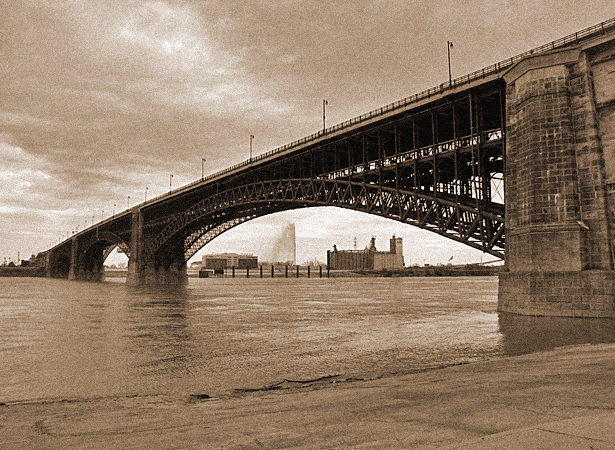
James Eads, then a young engineer, was also in Saint Louis, in 1849. Using diving bells, he salvaged the remains of the burnt riverboats there. During the Civil War, he built gunboats for the Union. After the war he built his bridge, Eads Bridge, the first bridge across the lower Mississippi.

In 1885 Mark Twain came west to revisit his childhood river. He planned to reacquaint himself with his river beginning in Saint Louis. Walking down to the riverfront he found the once busy and bustling waterfront of his youth now quiet and derelict. He asked one of the few remaining and idle riverboat men what had happened. In silent explanation, the man just pointed to the bridge.

The Mississippi may no longer be wicked, after all river pirates no longer routinely ply its ways, but it is still dangerous. Too many Americans find this out every year. Just as Robert E. Lee shaped the river, modern Army engineers do the same now. Riverboats now routinely haul coal, grain, and other goods. Now they do so relatively safely, where once the wicked river ruled.

Glorious Failures

Today, December 7th, “a day that will live in infamy”, is the 69th anniversary of the attack on Pearl Harbor.  Complete victory in the subsequent war and the passage of the intervening years have done little to assuage the emotions conjured by the memory of this day.  These very same emotions were only rekindled higher by the attacks on 9/11.  These two dates (December 7th and 9/11) now serve as the brightest stars in a constellation of American military defeats that have served our nation well with their drum-beating call-to-arms.

These two dates maybe the brightest in the American psyche, but they are not alone.  Preceding these dates were other defeats that have held similar sway, but due to the corrosive passage of time, memory of their actual dates have passed out of common knowledge.  Even so, their remembrance still survives.  Two examples events are the Alamo and the Little Big Horn.

All four events, the Alamo, the Little Big Horn, Pearl Harbor and 9/11 were not American victories and yet all four events remain revered.  The telescoping lens of history affords us the comfort of perspective.  The passage of time makes perfectly clear that while the first three events, the Alamo, the Little Big Horn and Pearl Harbor were loses; they also inevitably led to victory.  The 9/11 conflict is still ongoing and its eventual outcome is as yet uncertain.

Maybe the uncertain future causes us to cleave to these past defeats that were eventually overturned.  Cherished almost as talisman, each tragic loss has with time been burnished bright and now serves as an illuminating guidepost. These guideposts both accompany and also comfort us, as we march on into the approaching darkness, on to the promise of tomorrow’s glittering dawn.