The Game’s Afoot

On Sunday night, the PBS show Masterpiece Theater debuted in America the first episode of the 2010 BBC One series, Sherlock.  This modern-day adaptation of the classic Sherlock Holmes genre brings Mr. Holmes presumably kicking and screaming into the 21st century.

Did you know that according to the International Motion Picture Database (IMDb) that the character of Sherlock Holmes has appeared in more movie productions than any other fictional character, beating out even Santa Claus?  Anne and I learned this, to our chagrin, last Friday night, at the charity trivia night contest that we attended.

Sherlock’s Dr. Watson is a veteran of the War in Afghanistan, just as Sir Arthur Conan Doyle’s one was (the 1878-1880 one).  Like the original version of this character this one is troubled by his war experience.  Can you say post-traumatic stress syndrome?  This one can.  He is a wounded British Army doctor, discharged and left to wrestle with his own personal demons.  It is through Watson that we first meet Holmes.

Sherlock’s Holmes is a self prescribed sociopath and not a psychopath as one of his many enemies on the London police force claims.  He has no friends, is not interested in sex, is a drug addict and really only lives for the hunt, “Four serial suicides and now a note, it’s Christmas!”  Any Sherlock Holmes production will always rise or fall upon the quality of their detective.  Sherlock’s Benedict Cumberbatch is a worthy contender.  American audiences might remember Mr. Cumberbatch, or might choose not to, for his role in Atonement, as that most unwelcomed of all house guests.  His shock black hair, pale complexion and watery eyes combine to create a Holmes that the entire London police force aptly refers to as “The Alien”.

21st century London not only penetrates this Conan Doyle ethos, it permeates it.  Sherlock is alternatively, texting, losing, borrowing or finding a cell phone.  Our century’s manners have also overtaken this incarnation of Mr. Holmes, mores the pity for that.  One of the worst concession to our modern times though is the rewriting of that famous line, “Come on Watson, the game’s afoot” to “Come on Watson, the game is on”.  Even with its flaws, it is television worth watching.  At least, it is television that I’ll still be watching.

Graphics with this post come from the exhibit, Home Lands: How Women Made the West, which Anne and I saw on Sunday.  Include are works from Georgia O’Keeffe, Eve Drewelowe and Aki Sogabe.  Aki Sogabe’s work is one of a set of five in the exhibit that she used to design a mural for Seattle’s Pike Place Market.  These three work’s protective glass coverings have caught reflections in my photographs that only somewhat detracts from their beauty.
Home, Home on the Range


On Sunday afternoon, Anne and I went to go see the exhibit, Home Lands: How Women Made the West, at the Missouri History Museum.  This show originated at the [Gene] Autry National Center in LA.  After Saint Louis it will move on to Tulsa and Santa Fe.  The show from LA came divided into three geographical areas, Rio Arriba, Puget Sound and the Front Range.  The Missouri History Museum added a fourth area, Saint Louis.

The Saint Louis addendum acts as a gateway to the rest of the exhibit.  It starts with women’s involvement in early Western history, a time from when Saint Louis was on the edge of the frontier to a time where it had evolved into the Gateway to the West.  The Saint Louis section also covers women’s political activism in the 20th century.  Topics include the suffragette movement and subsequent political movements to protect the environment.  Until the former suffragettes turned their attention to air quality, you could measure soot on a Saint Louis sidewalk in grams per square foot.

The main Autry exhibit is much richer in content than the Saint Louis section.  The show has plenty of interesting and beautiful cultural and art objects enclosed in Plexiglas display cases.  All museum exhibits have those.  This show employs a multisensory approach of sight and sound to create individual stories of real women that are woven together in an almost crazy quilt fashion.  The show’s layout is free of form, so the visitor wanders easily from the Southwest to the Northwest, to the Rocky Mountains and back again.  I found myself circling back again and finding new aspects of this exhibit to experience.

Home Lands pays homage to the American woman of the West.  Particular care is taken to pay homage to all of her many faces, Native American, African American, Japanese American, Swedish American and many of the rest.  Home Lands portrays women working in the home, but also working outside of it, women working as farmers, doctors, fishermen, factory workers and many more occupations.  The conventional history of the American West is a male-dominated narrative.  This show aims to redress this imbalance.

The Last Stand

I’ve been reading Nathaniel Philbrick’s history, The Last Stand: Custer, Sitting Bull, and the Battle of the Little Bighorn.  Philbrick first splashed ashore the publishing world with his award-winning history, Mayflower, an engrossing account of the Pilgrims and their Native American counterparts.  With The Last Stand, Philbrick moves the European and American Indian conflict two centuries into the future and most of a continent away from where he began his recounting of it with Mayflower.  There is a large gulf of time and space between these two stories, but they make for suitable bookends to this tragic conflict, one near the beginning of armed conflict and one near its end. 

As his subtitle implies, Philbrick gives ample treatment to Sitting Bull and all of the other significant Native American and European characters leading up to, participating during and in the aftermath of the Battle of the Little Bighorn.  It is Custer though, that always steals the show.  While he was alive, he lived a lifestyle that was larger than life.  After his death, Custer was venerated as one of America’s most cherished of fallen heroes.  This sentiment continued until the 1960s, when the paradigm cowboys = good and Indians = bad began to dissolve.  Thomas Berger’s novel, Little Big Man, capitalized upon this shift in perspective.  Director Arthur Penn’s movie version, starring Dustin Hoffman, gave this viewpoint an even wider audience.

Come on, you Wolverines! – Custer to his Michigan calvary at Gettysburg

Philbrick mentions Little Big Man and discusses the profound impact that it had upon him at the time, but by the end of The Last Stand we are not left with the buffoonish cartoon version of Custer portrayed in Little Big Man.  Nor do we have Errol Flynn’s sainted version either.  Instead we are left with a complex, but flawed man.  Custer was able to parlay his military disaster into his stepping stone onto the stage of history.  Philbrick has shined the light of clarity upon Custer, but his light also acts like footlights, making the actor larger than life.

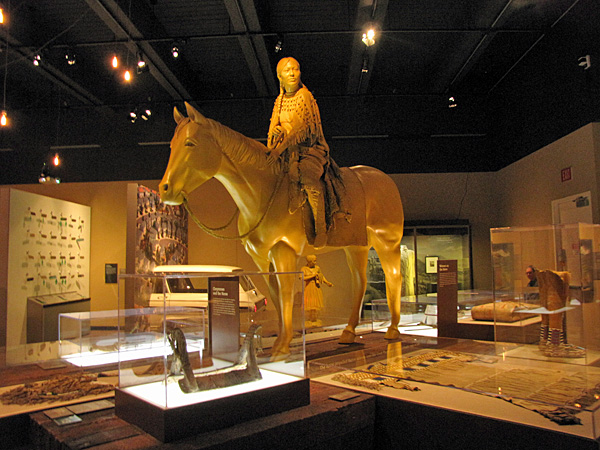
The photographs with this post were taken at the Indian Arts Museum in Grand Teton National Park.  Anne and I visited this museum last July as part of our Yellowstone vacation.  I have already published these photos and I don’t normally recycle my media, but they relate well to the content of this post, plus they are nice pictures too.  One of the reasons that I picked up The Last Stand was that during our Yellowstone trip we were only a couple of hundred miles from the battlefield, at least as the crow flies.  When we make it back to that part of this country, I would like to visit its site.  I expect it is not much to see, rolling, grass-covered hills, but I still want to see it, such is Custer’s fame.