‘Tis the Season

Winter Stars, by June Winter, wildflowers

Winter Stars, by June Winter, wildflowers

Work this week was in turmoil. There was the usual program politics, which level set the workplace angst. On top of all of this, was Friday, the final day in our open enrollment period for next year’s benefits. There’s no minute like the last minute. The angst can be fairly placed at the feet of Obamacare. As a Democrat I am entitled to say this. This year, we had a Cadillac healthcare program, or so it would have been judged, if the company hadn’t jacked-up our rates for next year. Like I said, there was a lot of angst this week at work.

A month ago, the previous paragraph would have been preamble to a mighty political rant. Today, I don’t really have the heart for it. I guess that the furor of this year’s election season has tamped down. All of our elected servants are back at work, doing what they do best, bickering. We’ve heard it all before and we will certainly hear it again, and again, and again, before it is finally all over. As we careen every closer to the looming fiscal cliff, I say let Toonces drive.

Although it was a little grayer than I had hoped, Saturday was way too unseasonably warm to spend all day railing against the Republican’ts. “Holy climate change Batman, to the bike cave!” Anne is still on the disabled list. She started PT for her injured knee this week. So, I’m riding solo today.

Afterwards, Anne and I returned to the park and went to the Missouri History Museum to view the Discover the Real George Washington exhibit. I’ll write about this show later, except to say that they had a pair of Washington’s false teeth on display and they weren’t wooden. The other main exhibit currently at the history museum is Missouri in the Civil War. We’ve already seen this show, but in the MacDermott Grand Hall separating these two shows, a museum intern put on a one woman dramatization of African-American history in Saint Louis, during the Civil War. After the show she took questions, but was quickly overwhelmed. Her boss stepped in and answered this question so thoroughly that no further questions were asked.

Except I saw the boss later and asked her about the Spirit of Saint Louis airplane that hangs in MacDermott Hall. She said that this replica of Lindbergh’s plane was built in 1928, the year after the famous transatlantic flight. It was built by Ryan Airlines, the same company that built the original plane. Our replica is quite special itself, having been featured in the movie “The Spirit of Saint Louis”, starring Jimmy Stewart. Both Stewart and his consultant, Charles Lindbergh, flew this iconic replica.

Jane Winter’s “Winter Stars” wreath is part of the collection on wreaths on display this Christmas season in the Ridgeway center at the Missouri Botanical Gardens. I like this wreath, but I really like the juxtaposition between the work’s tittle and its designer’s name. There are many other wreaths in this show and I’ll be doling them out, in this year’s run-up to Christmas.

Lincoln

Lincoln Penny

When they reached the place God had told him about, Abraham built an altar there and arranged the wood on it. He bound his son Isaac and laid him on the altar, on top of the wood. Then he reached out his hand and took the knife to slay his son. But the angel of the Lord called out to him from heaven, “Abraham! Abraham!” – Genesis 22.9-11

We carry him around in our pockets every day, and yet we still wonder who he was. Wonder and awe were both evoked by Steven Spielberg’s “Lincoln”. I urge you to run, not walk, to go see this movie. It is just that good. Anne, Joanie and I saw it in a sold-out performance on Saturday night at the Chase. At the heart of this movie is Daniel Day-Lewis’ extraordinary portrayal of Abraham Lincoln.

The crux of this movie is the legislative struggle to pass the 13th Amendment, the abolishment of slavery. The Civil War is still ongoing. Its ending is a foregone conclusion, yet thousands continue to die. Lincoln is left to make a Solomon-like decision, free the slaves, absolutely, or sue for an early peace and a less perfect union.

It has been said that diners should never see the kitchens of great restaurants. Likewise, patients should never view the basements of hospitals. Finally, the voting public should never witness the making of laws. This movie splays the sausage making wide. Lincoln’s henchmen were prohibited from using the newly minted half-dollar coins with his likeness on them, for bribes.

Employing all his wiles and through sheer force of will, he ramrods this legislation through Congress. Like his namesake Abraham, Lincoln was willing to sacrifice all for an ideal and very nearly did. “I am the president of the United States of America, cloaked in immense power. Go and get me those votes!”

Rare is the movie that so deftly captures its subject and so aptly captivates the audience. Critics have criticized, because that’s what they do, the bookending of this movie with the recitation of the Gettysburg Address and Lincoln’s Second Inaugural Address. They complain that their invocation was too heavy-handed. I thought that the Gettysburg Address was cleverly handled. The Second Inaugural Address serves as epilogue, replacing the man upon his pedestal.

With malice toward none, with charity for all, with firmness in the right as God gives us to see the right, let us strive on to finish the work we are in, to bind up the nation’s wounds, to care for him who shall have borne the battle and for his widow and his orphan, to do all which may achieve and cherish a just and lasting peace among ourselves and with all nations.

History has taught us of Lincoln the myth. This movie shows us Lincoln the man. We see him in his family life. We see him at his work. We see him feeling lighthearted and also dour. We see him as we have not seen him before. Other than that Mrs. Lincoln, how was the movie?

The Spirit of Saint Louis

The Spirit of Saint Louis

I am thankful for not having to go to work today, and also tomorrow and also this weekend. They’re be no paper airplane building this holiday. I’m thankful for a good job that has supported my family and does not require me to go to work on Black Friday, or even worse, Grey Thursday.

I am thankful for the spate of warm weather today that will allow me to go bicycling, before cooking the rest of the day. It was especially foggy on Wednesday morning. I knew that the airport was closed, because the Running Rabbit wasn’t going, as I passed underneath it on my way into work. The Running Rabbit is that ribbon of chasing lights that leads pilots into land, at night or in not too inclement weather. Dave posted a photo of similar weather in the early AM at Purdue. My suspicions were later confirmed that Chicago’s O’Hare Airport was also shutdown. Our country’s busiest airport was shutdown on its busiest day of the year. I’m thankful that none of my family was flying today.

Dave drove into town last night, completing his whirlwind cross-country sojourn. We trooped over to South Grand for our traditional pre-Thanksgiving Vietnamese dinner. Our atomic family is all together again and all valances are strong. I’m especially thankful for this.

I’m thankful for all our other family members, who we won’t be seeing this holiday. Many we have seen this year, but some we missed. We hope to see them again in the new year. We’re few compared to other families, but mighty. Some though, we won’t see again. I’m thankful that I have known, loved and been loved by them.

Thanksgiving is an American holiday. Yeah, I know Canada has one too. On this holiday, across this land, we attempt to recreate a mythical meal, once shared between our Pilgrim fathers and their Native American neighbors. A recent Slate article implicates the Pilgrims for plaguing these very same neighbors into extinction. Another Slate article contends that Turkey Day is really Dino Day. I am thankful for these holiday readings, it will stimulate table conversation.

Recriminations can abound when diaspora families reunite. There is always the big three, politics, religion and sex, three things better not discussed at the dinner table. Interesting, but inconsequential small talk can be a godsend. I’ll be thankful for turkey sandwiches after the all the hub-bub dies down again.

As you travel into and through this holiday, don’t imagine yourself as some lone aviator, trying to be the first to cross the Atlantic. Lindbergh’s triumph eventually turned to tragedy. Enjoy the parade. You’ll see some of the most significant people in your life, parading before you during this holiday. Be thankful for them and enjoy them!

For Supremecy

For Supremecy, Charles M Russell, 1895

As he conversed with his Indian friends, Russell heard many accounts of intertribal warfare among the Blackfeet, Crow and Sioux earlier in the century. One bloody conflict occurred in 1866, when the Piegan Blackfeet were said to have killed more than 300 Crow and Gros Ventres near the Cypress Hill, exacting revenge for the murder of a prominent chief. Such conflicts usually involved a mounted charge into close combat, as Russell shows here. The warriors fought with a variety of weapons, and valor and victory were viewed as the sum of individual efforts. Although Russell’s painting is remarkable for its wealth of detail, it ignores the fact that warriors generally stripped down to the bare essentials for battle. Objects such as the painted buffalo robe or those with beadwork decoration are left behind.

Scopitone

Scopitone was a 1960s era type of jukebox featuring a 16 mm film component. Scopitone films were a forerunner of modern music videos. The first Scopitones were made in France. I became aware of these videos through my brother-in-law Carl. He first showed me them last September while we were busily preparing to travel to Lopez Island for Robyn’s wedding. I don’t know if Carl was nervous about traveling there, but I was. We watched his Scopitone music videos, as a sort of pre-game warm-up exercise. He later sent us the DVD. “Pussy Cat A Go Go”, performed by Stacy Adams and the Rockabily Boys, was the first video on the disk. Yes it is plainly misogynistic, but it is also a product of it’s time, plus it’s French. The second video, “What I Say”, by Sylvie Vartan is not sexist, but it is even more French, Est ce Que Tu Le Sais.

East Mound City

Our “big” weekend bicycle ride occurred on Saturday morning. We drove across the river to the Cahokia Mounds National Historic Landmark. From there we bicycled Trailnet’s Mounds Trail Interpretive Bike Ride. This ride featured a mass start of about 50 cyclists and everyone stayed together throughout the ride. Harold, our interpretive guide set the pace and one of Trailnet’s vans guarded our tail end. We rode from Cahokia Mounds to the East Saint Louis riverfront. It was a 20 miles roundtrip. The pace was slow, probably 12 MPH, and there were frequent stops for interpretation. It was a real ‘three-hour tour’. 😉

Anne Cycling Past Monks Mound

One of Saint Louis’s nicknames is Mound City. At one time there were 50 Native American mounds in the City of Saint Louis, now there is only one. While our ride on Saturday did not cross the river, the Mounds Heritage Trail spans both sides. Most of the mounds are within the Cahokia Mounds Historic Site, but one outside this site was pointed out along our ride, the Sam Chucalo Mound. Story has it that a road construction crew wanted to dismantle this mound for fill dirt, but Mr. Chucalo, the landowner wouldn’t allow it.

The ruins of an ancient lost civilization were only half the story of this ride. The other half of the tour was mostly in ruins too. That would be East Saint Louis. Once dubbed the Pittsburgh of the West, because of its concentration of heavy industry, our guide joked that it is now one of the greenest cities in America. What he meant was that the natural undergrowth is reclaiming large tracts of the city as much of it slides into decay. There are a few notable exceptions to the debilitation of this once proud and wealthy city. The Federal Courthouse, the Ainad Temple and the Katherine Dunham house are a few choice examples of what has survived. While the Spivey Building, the Majestic and the Murphy Building with their once beautiful facades tell of what has been lost.

East Saint Louis is an African-American community. Fifty white bicyclists parading around town on a Saturday morning was obviously not a normal sight. Universally though everyone was very friendly to us. People would wave and call out. Motorists would toot their horns, in the nice sort of way. A Bi-state bus even tooted us a salute. A fellow rider remarked on how much more friendly the drivers were here than in Saint Louis proper. A local woman cyclist joined our procession for a while. She was full of questions, “Where did you come from?” “Where are you going?” Etc. We tried to get her to accompany us down to the riverfront, but she begged off saying, “I’ve got to get one of those Mercedes bicycles that you all have.”

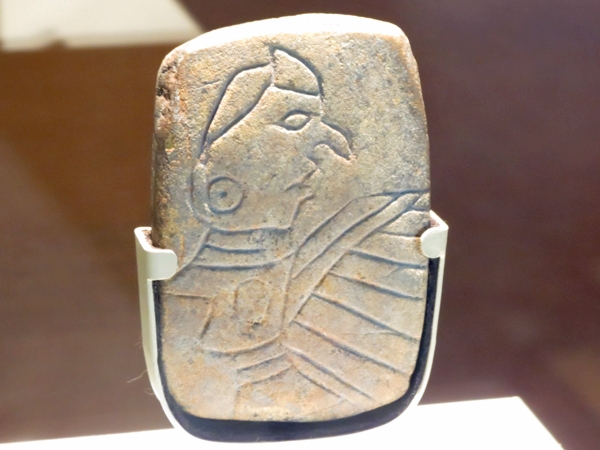
The Birdman Tablet

This was one of the most interesting and moving bicycle rides that I have ever ridden. After the ride, one of the other cyclists thanked our guide and sponsors saying, “I’ve lived in Saint Louis all of my life and I had never been to East Saint Louis before. It is a part of our community that I had never seen. Thank you.” H.G. Wells once quipped, “Whenever I see an adult on a bicycle, I have hope for the human race.” I think that his quote sells the human race short, for the adult on the bicycle sees the rest of the world more clearly too.