Roids – Aster, not Ster or Hem

A Cabin Night Sky

A Cabin Night Sky

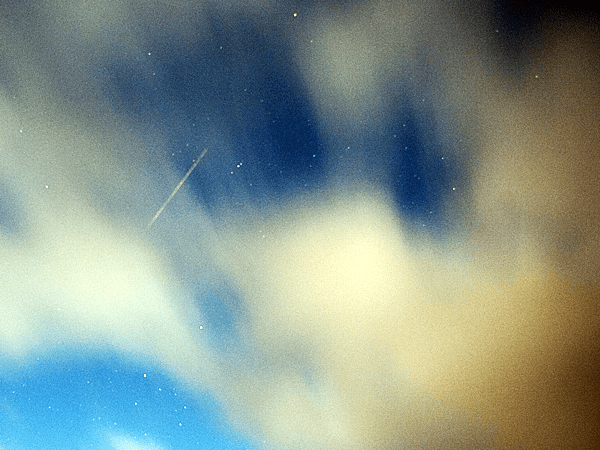
Is it a bird, a plane, Superman? The streak in this post’s photo is likely a plane. it might be a satellite, but it is unlikely a meteor, let alone a killer asteroid. I was planning on devoting this entire evening to romancing my honey, but if the world is going to end tomorrow, I felt that it was only fair to give my dedicated readership a heads up. The asteroid DA14 is scheduled for a near miss of the Earth tomorrow. It is not supposed to strike our planet, but you know how these things sometimes go. Yeah, right!

DA14 should careen by the opposite side of the Earth from us, sometime after 1:30 PM Saint Louis time. It is small by asteroid standards, only about half a football field in length (160 feet). It will pass close by, only 17,000 miles from us, hardly anything in astronomical terms. Because it is so small, it will not be visible to the naked eye. It will pass between two belts of man-made satellites, above the GPS satellites, but within the orbits of geosynchronous satellites. It is deemed unlikely though that it will strike any of these craft, even though it will intersect the geosynchronous ring twice, because space is really a very big place. Once, DA14 passes by, Earth’s gravity will fling it away, such that it is unlikely to ever return.

A similarly sized asteroid is thought to have caused the 1908 Siberian Tunguska event. In that event trees were knocked down and set aflame for hundreds of square kilometers, and anyone within 10 kilometers probably wouldn’t have lived to tell the tale. Let me repeat, a reoccurrence of this type of event with DA14 in not expected. A similar strike by DA14 would not be a good thing, but DA14 sailing close by so that all the astronomers can geek-out over it, now that is cool.

UPDATE: Last night (in the morning local time) a meteor streaked across the Russian sky. It was as bright as the sun and its sonic boom injured 400 people with falling glass. This event is not believed to be related to DA14.

Science Fact and Fiction

Eye of Sauron - Fomalhaut's Debris Ring - NASA Photo

Eye of Sauron – Fomalhaut’s Debris Ring – NASA Photo

Fomalhaut is a bright star that is located 25 light years away in the constellation Pisces Australis, or the Southern Fish. The above picture is a recent image captured with the Hubble [not Hobbit] Space Telescope. It makes this system look uncannily like the Great Eye of Sauron from the Lord of the Rings movie trilogy. The ring is composed of dust particles in orbit around the star.

The Obama Administration operates a website, called “We the People”. This website solicits petitions from ordinary citizens, with the promise that the Administration will give a formal response to any petition that garners over 10,000 signatures. One such petition asked the government to “secure resources and funding, and begin construction of a Death Star by 2016.” The following is the humorous response:

This Isn’t the Petition Response You’re Looking For
By Paul Shawcross

The Administration shares your desire for job creation and a strong national defense, but a Death Star isn’t on the horizon. Here are a few reasons:

  • The construction of the Death Star has been estimated to cost more than $850,000,000,000,000,000. We’re working hard to reduce the deficit, not expand it.
  • The Administration does not support blowing up planets.
  • Why would we spend countless taxpayer dollars on a Death Star with a fundamental flaw that can be exploited by a one-man starship?

These two independent stories are still both linked with their twin conjunction of science and fiction and the humor that this meeting engenders. Both stories prove the old adage that truth is often stranger than fiction and funnier too. This post may be a bit nerdy, probably too much so for some, to them I can but say, “May the Schwartz be with you”, some day. For those other diehard fans, not willing to submit to the Administration’s edict, I offer this photo link.

Scientists dream about doing great things.
Engineers do them.
– James A. Michener

First Quarter Moon

First Quarter Moon

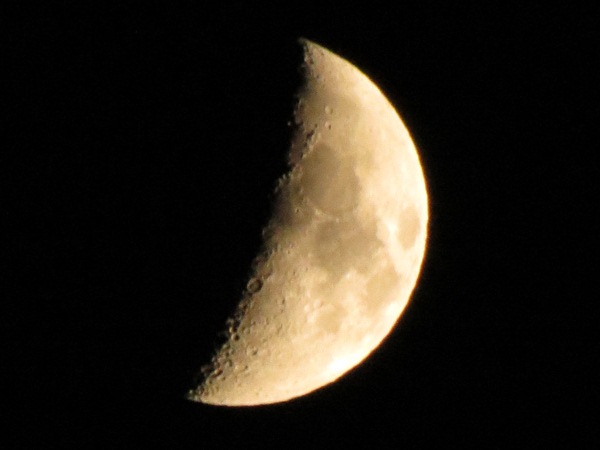
Last Saturday, was the first day of Fall, which coincides with the autumnal equinox. It was also when the first quarter moon last occurred. Last Saturday, was part of a dark and stormy weekend in Ann Arbor, but it did clear for a while on Saturday night. This was fortunate, because our 40th high school reunion was held then, in an open air venue.

Next time, at our 50th reunion, our class will have mostly morphed from working adults to retired seniors, except for a few holdouts. These superannuated workers may want to continue to work, but most will do so, because they have to. The Great Recession will ensured that more than otherwise will continue to hold jobs ten years from now.

Most of our classmates had children, but I was surprised at how few of them spoke of grandchildren. I didn’t see a single baby picture. Maybe Anne has a different take?

The airs of pretentiousness have faded with each decade’s reunion. With the passage of time the need to impress former classmates continues to recede. Combining all of the city’s schools into one reunion ensured a good turnout. Future reunions will have no such expediencies to arrest the declining classmate population.

Starry Night – Bright as Day

Starry Night – Bright as Day

I’m back in the Lou again and I’m back at work too. Yesterday, I braved another marathon rocket shot and drove all the way back home from the cabin in just one day. 750 miles makes for a long day; especially when you are doing all of the driving by yourself.

It is still hot here. How hot is it? It is triple-digit hot, 106 °F to be specific. It is so hot and dry that I predict that it is going to take a hurricane to break this summer’s heat spell and drought. It will actually only be the remnant of a hurricane by the time that this first named storm hits Saint Louis, but it will dump a bunch of rain and breakup the prevailing weather patterns that have us locked in their grip this summer. Unfortunately for Saint Louis the hurricane season is still too many weeks away.

The photo with this post is another one of my night photographs from last week at the cabin. I had high hopes for some spectacular night shots, but this one and a few more are the only ones that are even presentable. I had hoped to capture the Aurora borealis and one night last week there was a large flare solar event that promised an excellent opportunity to observe and photograph the northern lights. I checked the websites that do Aurora borealis forecasts and I was well within the observable region, but unfortunately the weather forecast was not onboard, cloud cover spoiled that one and only chance.

Another photo-op missed was something called the Iridium flash or Iridium flare. The Iridium satellite constellation is composed of many low earth orbit communications satellites. The Iridium satellites are what make satellite telephones work. You know the kind of mobile phones that news reporters use when they are in a remote location, like Afghanistan? The Iridium satellites have several key features that make observing and photographing them interesting. First, they have a single large solar cell panel. When this panel is properly aligned, it causes a bright reflect flash of sunlight. It can be as bright as the full moon, bright enough to be seen in daytime. Now this flash is narrowly focused, so it can’t be seen over a wide area, just tens of kilometers. There are many Iridium satellites and they travel in a low earth orbit, so these events are reasonably frequent. My problem here was a combination of my unwillingness to stay-up all night and some faulty forecasting. So, I never got to see any of these flash events.

Finally some of my problems were of my own making. I learned today that I didn’t have all of the settings on my camera set properly. Now I have corrected these mistakes, so that next time I might be able to generate better pictures. Practice always makes perfect. Isn’t that what they say?