Swing Low, Sweet Chariot

Swing Low, Sweet Chariot by John McCrady, 1937

“Swing Low, Sweet Chariot” is a historic African-American spiritual. It was first written by Wallis Willis, a Choctaw freedman in the old Indian Territory, sometime before 1862. He was inspired by the Red River, which reminded him of the Jordan River and of the Prophet Elijah’s being taken to heaven by a chariot (2 Kings 2:11). McCrady’s painting shows mourners hovering over a deathbed visible through the open door of a cabin, while angels descend to take a newly departed soul to heaven in a chariot. The painting is full of rural and spiritual imagery. The song, “Swing Low, Sweet Chariot”, is sung in choral below.

Anne and I attended the soul food supper at the MRH high school. This is the school districts traditional celebration at the close of Black History Month. In this context the choice of “Swing Low, Sweet Chariot” seemed appropriate to the season. On a more personal note, Anne’s Aunt Fran passed away last week. So the painting has a personal connection too.

Fran never stuck me as a particularly religious person, but I wouldn’t categorize myself as one either. I found her to be a kind, loving and caring person and if these aren’t religious values, then I don’t what is. My interjection of religious themes is not to be construed as a form of proselytizing. It is just that when the big themes arise, the life and death themes, I find it easier to fall back upon religious tradition. It offers a set of Arthur Murray steps for life to follow.

Fran made our wedding cake. I wish that I could have enjoyed it more than I did at the time. My problem was with the ceremonial feeding of the groom. I must admit that I started it, but Anne surely retaliated. I wonder if she would have been so exuberant then, if she could have seen her husband now. I should have manned up, instead I asked for a glass of water. Fran was rightly horrified. She taught home economics, don’t you know. In retrospect, I blame the server and not the cook. No tip for her! Fran also created an anniversary cake, which I did enjoy, because I served myself.

In later years, she switched from making me cakes to Fran-hattens, which I never had any problems getting down. When I pull up to the Cabin this summer, I’ll look for her, but she won’t be there. I want to pray for her.

She’s gone over before I did, coming for to carry me home. I hope she cuts a hole and pulls me through, coming for to carry me home. Since, you got there before I did, coming for to carry me home. Tell all our friends I’m coming too, coming for to carry me home. God bless you, Fran.

Dedicated to Art and Free to All

West Grand Stairs

Saturday, we went to the art museum. We drove to De Mun and then walked from there. Driving, cut out a mile, of counting hub cap spokes, each way. We walked through Kennedy Forest and saw lots of little birds. We got post-worthy photographs of an Eastern Bluebird, a pair of Downy Woodpeckers and a male Cardinal. We approached the Saint Louis Art Museum, the Slammer, from the southwest. Circling counterclockwise, we toured the construction site that is the new wing of the museum. We spoke with one of the construction workers, who when asked, said with a shaking head that the new wing would be done in May. Only later did I discover that he probably meant May of 2013.

There is still a multi-story crane and plenty of earth moving equipment about, but work must have progressed beyond the pile driver part of the project, because the eastern galleries of the museum are beginning to be repopulated with art. We skipped the main, ticketed exhibit, “An Orchestrated Vision: The Theater of Contemporary Photography”, because there was so much new to see for free. The title of this post is taken from the inscription on the lintel above the main, and at this time, only entrance to the museum. When Anne worked at the Corps, there was a manager named Art. She once bought an art museum t-shirt, with its motto on it, for his secretary. The secretary was not amused.

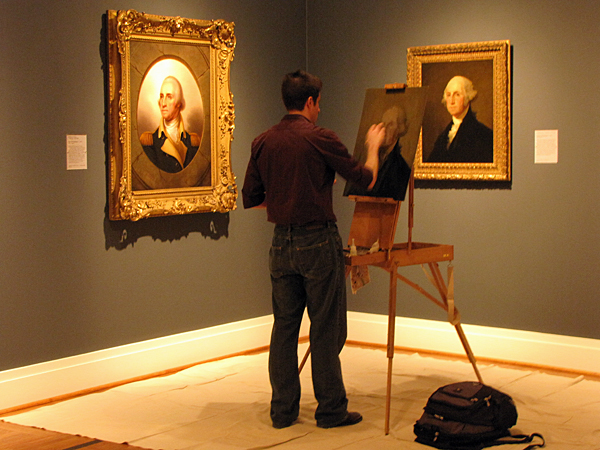
I was going to call this post, “Art for Art’s Sake”, which Anne thought would more truthfully be called “Art for Blog’s Sake”. The museum allows some non-flash photography, so it is an excellent source for blog fodder. Don’t expect to see any great works of art in this post though. The first photo is a house of mirrors treatment of the West Grand Stairs. The second one shows a painter copying a Gilbert Stuart portrait of George Washington, which Stuart made a living out of copying too. I asked him what he was doing, thinking that he might be some sort of museum demonstration. It turned out that he is a student, taking a painting class at the museum. He also had his own personal art guard, just to ensure that no untoward mustaches appeared.

The Painter

One exhibit that could not be photographed was a movie called “Single Wide”. This short film shows a young woman, a pickup truck and a trailer home. The following paragraph is from the museum’s description of the film.

Teresa Hubbard and Alexander Birchler’s film Single Wide, the upcoming New Media Series installation, presents a gripping, though deliberately enigmatic, six-minute story. Shot on a meticulously staged set, the film offers a glimpse into the tormented life of a young woman living in a trailer home. Hubbard and Birchler’s production purposefully offers its audience a highly constructed setting in which detail and ambiguity is skillfully juxtaposed. The film’s intensity and brief yet seamlessly looping story entice viewers to watch Single Wide endlessly – identifying more clues with each pass, but coming no nearer to resolution.

The movie does loop seamlessly, both in time and space. In time, the movie is played as a continuous loop. I ended up watching it several times, before fully realizing this. It also loops in space. The camera is continuously circling the woman, the truck and the single wide. This dual looping effect makes this short movie a compelling film, yet one that poses more questions than it answers.

The Nose Knows

The Saint Louis Art Museum has an exhibit of prints, by William Kentridge, entitled Nose. Nose is a series of thirty prints inspired by Nikolai Gogol’s short story The Nose. The Metropolitan Opera commissioned Kentridge to direct a modern interpretation of Shostakovich’s opera, by the same name. The tale of the story begins with a Russian bureaucrat, waking up one morning to find that his nose is mysteriously missing. The absurdist narrative follows the journey of the protagonist to locate his nose. In the print exhibit, Kentridge elaborates on Gogol’s tale by picturing the nose independent of the face, “free to make its own way in the world.” I have chosen Nose 28 as a representative for this exhibit. Here is the museum’s explanation of this work.

In a nod to Russian Constructivist posters, Kentridge makes an energetic composition out of the red letters, “XA.” He was drawn to this phrase because it was designated in the singer’s transcript of Shostakovich’s opera “The Nose” as a cue for laughter – an important musical element in that production. Kentridge sees laughter and the absurd in art as “an active and productive way of understanding the world.”

 I’ve offered up this Russian absurdist interlude only as prelude to my discussion of this week in American politics. I’m speaking of the Kabuki Theater that is our nation’s budgetary process. You know though, Kabuki Theater has become so overused these days that I’m switching to Russian absurdist theater, the new Kabuki Theater. [Note: need to polish that new part.]

So brave Odysseus sailed the ship of state, between the twin terrors of Scylla and Charybdis and brought us safely again to calm waters. Except that is not the way that Homer wrote it and that is not what happened last week. In the book, Odysseus had himself lashed to the mast so that he could hear the sirens song, but still resist it. If by resisting, you equate being forcibly restrained, then by leadership, you must also equate this last week’s proceedings, because in neither case was freewill involved. I’ll leave it to the reader to cast the part of Odysseus, but I will offer up two, President Barack Obama and Speaker John Boehner.

Casting Barack Obama as Odysseus requires also casting Jimmy Carter and Bill Clinton as Scylla and Charybdis. One president he does not want to become and one president that he would never be. One wailing a song of warning, one singing softly, come here, baby. Strapped to the mast of his presidency, Obama is confined from freely choosing anything that will jeopardize 2012.

With John Boehner the whirlpools lie within his own party. Will he be able to sail down the mainstream or be sucked down to the right? With many more budget battles yet to be fought, not even Delphi could predict the fate of Boehner as Odysseus, but as the sole elected, national leader of the Republican party, he has to balance party politics and our nation’s business. Maybe he too relishes the opportunity to be strapped to the mast and let the fates decide all?

I heard a good joke about Boehner. He has been known to show his emotions. Being a conservative, you could call him a compassionate conservative, but like Kabuki Theater, that is so over worked, how about, emoticon? 😉

German Expressionism

Staring before 1848, German immigrants emigrated to Missouri in general and Saint Louis in particular. Missouri’s broad rivers and their accompanying valleys reminded these then new Americans of their native Rhine and other river valleys. The revolutionary year of 1848 only accelerated this emigration. The failed revolutions of that year unleashed an avalanche of German and central European intellectuals, idealists and revolutionaries, who fled the retribution that was soon meted out by the hereditary regimes that had and continued to rule most of Europe. Many of these immigrants grew and prospered here in Saint Louis.

Saint Louis in general was a beneficiary of the work and effort of these German immigrants. The Saint Louis Art Museum was a rather particular beneficiary of Saint Louis’ German-American heritage. One after another prominent Saint Louisan family bequeathed their artwork collections to the museum. Eventually, the museum found itself with one of the première collections of modern German art. This aspect of the museum’s collection is so important, that even now, at the height of the construction of the new wing, German Expressionism still commands a large gallery of the still functioning art museum. The accompanying pictures and the following text are devoted to German Expressionist art. The following text is from a placard in the gallery.

At the beginning of the 20th century, avant-garde German artists pursued a new visual language known as Expressionism, which was characterized by intense color, exaggerated imagery, and agitated brushstrokes. The two pivotal Expressionist movements were Die Brücke (The Bridge) centered in Dresden and Berlin from 1905 to 1913, and Der Blaue Reiter (The Blue Rider), active in Munich from 1911 to 1914.

Die Brücke, led by Ernst Ludwig Kirchner, Karl Schmidt-Rottluff, and Erich Heckel, favored the use of vivid colors, strong linear effects, and bold outlines. They were inspired variously by German Renaissance art, Post-Impressionism, Fauvism, Cubism and African and Oceanic art. Brücke artists depicted familiar people, places, and experiences with emotional forces and an almost raw effect. Their subjective response addressed both the frenetic pace of modern urban life, and the tranquility of idyllic retreats.

Der Blaue Reiter believed that art expresses spiritual truth. Its practitioners employed different styles to achieve these aims as evidenced by Wassily Kandinsky’s radically simplified, nearly abstract paintings, and Franz Marc’s interlocking planes of color. These artists engaged the world in order to transcend it.

The Saint Louis Art Museum has engraved upon the lintel above its entrance, its motto, Dedicated to Art and Free to All. It was engraved there for the opening of the 1904 World’s Fair. Many a pretty young woman has worn that motto across their chest since then. Admission is always free to any museum gift shop. This motto extends to the museum’s permission for photography of its permanent collection. It is this permission that has allowed me to photograph and present these works of art. In our ever more proprietary world, where copyright rules supreme, this freedom to express, is a welcomed echo of the freedom sought, by those early German immigrants, so many years ago.

Fiery Pool

Anne and I drove to the Park to view the special exhibit, now showing at the art museum, Fiery Pool: The Maya and the Mythic Sea. Photography was not allowed within this exhibit due to “copyright” issues. I should have questioned this explanation, all of the 90 works displayed were between 500 and 2000 years old and I’m pretty sure not even Disney will be able to maintain their copyrights that long, Shakespeare hasn’t. Anyway, here is the SLAMmer’s blurb:

Fiery Pool: The Maya and the Mythic Sea brings together over 90 works, many never before seen in the United States, to offer exciting insights into the culture of the ancient Maya. Surrounded by the sea and dependent on the life-giving power of rain and clouds, the ancient Maya created fantastic objects imbued with the symbolic power of water. This exhibition presents four thematic sections—Water and Cosmos, Creatures of the Fiery Pool, Navigating the Cosmos, and Birth to Rebirth—that explore the different ways Maya artists represented water, from setting religious narratives in watery domains to using shells and other exotic materials acquired through coastal trade networks

There was no mention of 2012 or even Mel Gibson’s Apocalypto, in the exhibit. The Mayan connection with water was constantly reinforced. I was not aware that the Mayan pictograph language has only begun to be deciphered in the last thirty years. There was little mention of human sacrifice in the exhibit. Was this omission, or am I confusing the Mayans with their more bloodthirsty neighbors or just Mel Gibson’s viewpoint? Anne and I both used the iPod tour. I pretty much just stuck with the tour, while Anne made sure to read every card. Needless to say, I was done well before her. I spent the rest of my time, photographing portions of the SLAMmer’s private collection. Dedicated to Art and Free to All is still inscribed upon the lintel above the main entrance. Pictured below is a ballgame vessel, part of the permanent collection.

This vessel depicts an ancient Mayan ballgame with a sense of dynamic spectacle. Like the ballgame itself, the story is not seen all at once, but unfolds in sections as the viewer moves around the vessel. The ballgame seems very close to our own team sports, with players wearing the insignia of animal mascots and spectators avidly watching and gossiping in the stands.

Leaving the museum, late afternoon, a spring snowstorm was in full force. We drove to REI in an attempt to spend our dividend, but the line was too long. We shopped Whole Foods and then went out to dinner. We tried the Maya Café, but it was too early and it hadn’t opened yet. We went around the corner to Las Palmas, a Mexican restaurant. There was a Mexican soccer game on, broadcasted from San Diego. It was interesting hearing all the familiar commercials being broadcasted in Spanish. Barack Obama had a political commercial that aired. 2012 is supposed to be a big year in the Mayan calendar; it is an election year here. Recent census data counts a sixth of all Americans as Hispanic. 2012 could be a seismically active political year.

Aaron Douglas

This post is founded upon a visit I made to the Saint Louis Art Museum in January. It focuses upon the works of the African-American artist Aaron Douglas. This post is made possible by the policies of the Saint Louis Art Museum. The Museum permits photography of almost all of its galleries. More importantly though is its freedom of access. The Museum’s motto is carved above its door, “Dedicated to Art and Free to All”, which means free admission. Aaron Douglas’s artwork is on display in Gallery 321 until April 10, 2011. I hope that you can see all of his works on display, with your own eyes.

Aaron Douglas was a leading figure of the Harlem Renaissance, a cultural movement during which the arts flourished among New York’s booming population of African-American intellectuals. Douglas and his contemporaries created art and literature rooted in the experiences of African-Americans and in themes of political change and social uplift.

Douglas’s simplified, silhouetted figures, flat planes of color, and bold geometric patterns incorporated elements of modernism, but were also strongly influenced by the art of West Africa and ancient Egypt. He sought to create art that was not only formally innovative, but also addressed the lives of African-Americans, a subject largely ignored in American art. Like other artists of the Harlem Renaissance, Douglas helped construct a new paradigm for a positive African-American identity through his work, acknowledging the historical achievements and ongoing contributions of African-Americans to modern culture and society.

Born and raised in Topeka, Kansas, Douglas moved to Harlem in 1925 and immediately engaged with the artistic, literary, and scholarly scene he encountered. His visually striking paintings and murals brought great acclaim, as did his collaborations on illustrated books, periodicals and folios with celebrated poets and authors such as Langston Hughes, Countee Cullen, and Alain Locke.

Douglas exerted a powerful influence upon later generations of artists through both his teaching position at Fisk University, which he held from 1938 to 1966, and his artwork.

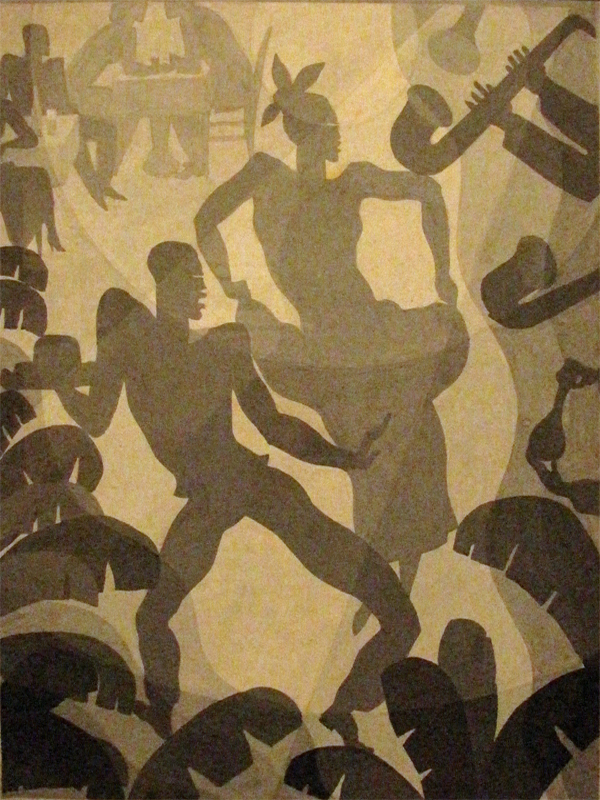
Dance demonstrates Douglas’s interest in celebrating Harlem nightlife and the contributions African-Americans have made to American culture. He captures the energy of a pair of dancers by surrounding them with wavy lines and overlaying the entire image with a series of concentric circles. Douglas also employs banana leaves as a framing device and an allusion to the dancers’ African heritage. Douglas wanted to connect jazz, the dancers, and his own role as an artist to a larger cultural tradition with its roots in Africa.

Douglas references the historical oppression of African-Americans with this monochromatic representation of a chain gang, rendered in the artist’s characteristic style. The workers wield pickaxes, while the sedentary bosses in the foreground hold firearms, confirmation that the scene depicts forced labor. In some areas of the South at the turn of the century, officials would arrest African-Americans on false charges. These prisoners were forced into hard labor, a practice that served as an institutionalized mechanism for exploiting African-Americans after the abolition of slavery. 

Noah’s Ark is related to an illustration Douglas created for James Weldon Johnson’s God’s Trombones, a book of poetry based upon the sermons of African-American preachers. Douglas wanted to provide an alternative to earlier Christian art, in which people of African descent were either depicted as servants or not represented at all. In this work, Noah stands at the bow of the ark as supplies and animals are loaded into the ship. A beam of light extending from the corner of the painting emphasizes Noah’s connection to God, while wavy lines and lightning bolts refer to storms to come.