Eero Saarinen

Knoll Armchair, Designed by Eero Saarinen

It is always a bit disconcerting to see something familiar, in an unexpected setting, like an everyday object in a museum. I’m not speaking of some nameless village’s cabinet of curiosities, but a real museum, the Saint Louis Art Museum. It is a beautiful object, so to call it everyday is demeaning, better to call it familiar. My mom purchased four of these chairs, for her dining room set. I’ve sat in them for countless meals. Not only do they look good, they’re comfortable too. Rather than disconcerting, I think that she would find it comforting to hear that her chairs are in our art museum. It would be a vindication of her good taste. Me seeing this chair in the museum, was a reminder of her.

The following is an excerpt from the museum’s writeup.

Architect Eero Saarinen’s sleek, sculptural design is an icon of 20th-century furniture. Prior to World War II, he collaborated with Charles Eames on designs for organic furniture using bentwood. Following the war, Saarinen’s furniture designs employed new materials like plastic to achieve a modern form. This chair’s one-piece base was designed to replace the visual clutter of traditional furniture. In Saarinen’s words, “The undercarriage of chairs and tables in a typical interior makes an ugly, confusing, unrestful world. I wanted to cleat up the slum of legs. I wanted to make the chair all one thing again.”

Eero Saarinen, doesn’t he have some other art work around town? I think it is a sculpture piece. It will come to me. 😉

Race

The Mississippi by John Steuart Curry, 1935

The comedian, Chris Rock, once joked about Black History Month. He complained that the shortest month of year had been picked, February. Weather-wise, February was also the worst month of the year. Rock’s complaint was that with twelve months to choose from, why did black people end up with the shortest and most dismal one. This year at least, Black History Month was granted an extra day. If Black History Month was allotted the maximum thirty-one day, then yesterday would have been February, 31st, instead of March 2nd. For the sake of discussion, let’s assume the former, and grant this amateur blogger one more day of grace to write this up. Last night, we went to see The Rep’s production of David Mamet’s play, “Race”.

Mamet is a connoisseur of four-letter words, but when it comes to the four-letter word, race, I prefer another David, David Blight. He is a Yale professor and author, and is on an iTunes U lecture series about the Civil War; he is my preferred instructor on the subject of race. Mamet’s white lead states that there is nothing that a white person can say to a black person about race. According to Blight that hasn’t stopped white people for the last 150 plus years from trying. Blight leavens these white voices, with black voices and composes a symphony, on this pivotal period in American history and in American race relations.

Returning to Mametland, “Race” is set in the present. It is a four actor play. There are Lawson and Brown, the white and black male law partners. There is Strickland, the rich, white defendant, accused of raping a younger black woman. Then there is Susan, also young black woman, and recent addition to the firm. Only Susan’s character has no last name. Mamet’s stacatto dialog spans two acts, and multiple aspects of jurisprudence. The subject of race is intertwined throughout these discussions. Lawson argues the law, but the crux of his argument always returns to race.

The Civil War was this nation’s struggle to expunge the stain of slavery. Read about the 13th Amendment. This war’s death rolls dwarfed all other American wars, both before and since. Even with this sacrifice, it took another hundred years before Civil Rights gained any traction. We are now sitting fifty years beyond that point. This is also the timeframe of Mamet’s play, except that all of the characters, save maybe Susan, are too old to successfully digest this last half century in race relations. This gives Mamet’s play a stale, dated feel. Its opening joke about OJ only underscores this sense. Only the recent DSK scandal, offers this play any touchstone to the present. That event dealt more with relations between the sexes rather than the races. Mamet confronts similar sexual issues, but always returns to race.

John Steuart Curry’s painting, “The Mississippi” has little to do with race, save that the family that is stranded, is black. Curry also painted farm animals, caught in similar predicaments. These paintings depict the 1927 flood, a scourge visited upon man by God. Race is a scourge that man alone devised and someday, we shall overcome.

Swing Low, Sweet Chariot

Swing Low, Sweet Chariot by John McCrady, 1937

“Swing Low, Sweet Chariot” is a historic African-American spiritual. It was first written by Wallis Willis, a Choctaw freedman in the old Indian Territory, sometime before 1862. He was inspired by the Red River, which reminded him of the Jordan River and of the Prophet Elijah’s being taken to heaven by a chariot (2 Kings 2:11). McCrady’s painting shows mourners hovering over a deathbed visible through the open door of a cabin, while angels descend to take a newly departed soul to heaven in a chariot. The painting is full of rural and spiritual imagery. The song, “Swing Low, Sweet Chariot”, is sung in choral below.

Anne and I attended the soul food supper at the MRH high school. This is the school districts traditional celebration at the close of Black History Month. In this context the choice of “Swing Low, Sweet Chariot” seemed appropriate to the season. On a more personal note, Anne’s Aunt Fran passed away last week. So the painting has a personal connection too.

Fran never stuck me as a particularly religious person, but I wouldn’t categorize myself as one either. I found her to be a kind, loving and caring person and if these aren’t religious values, then I don’t what is. My interjection of religious themes is not to be construed as a form of proselytizing. It is just that when the big themes arise, the life and death themes, I find it easier to fall back upon religious tradition. It offers a set of Arthur Murray steps for life to follow.

Fran made our wedding cake. I wish that I could have enjoyed it more than I did at the time. My problem was with the ceremonial feeding of the groom. I must admit that I started it, but Anne surely retaliated. I wonder if she would have been so exuberant then, if she could have seen her husband now. I should have manned up, instead I asked for a glass of water. Fran was rightly horrified. She taught home economics, don’t you know. In retrospect, I blame the server and not the cook. No tip for her! Fran also created an anniversary cake, which I did enjoy, because I served myself.

In later years, she switched from making me cakes to Fran-hattens, which I never had any problems getting down. When I pull up to the Cabin this summer, I’ll look for her, but she won’t be there. I want to pray for her.

She’s gone over before I did, coming for to carry me home. I hope she cuts a hole and pulls me through, coming for to carry me home. Since, you got there before I did, coming for to carry me home. Tell all our friends I’m coming too, coming for to carry me home. God bless you, Fran.

Dedicated to Art and Free to All

West Grand Stairs

Saturday, we went to the art museum. We drove to De Mun and then walked from there. Driving, cut out a mile, of counting hub cap spokes, each way. We walked through Kennedy Forest and saw lots of little birds. We got post-worthy photographs of an Eastern Bluebird, a pair of Downy Woodpeckers and a male Cardinal. We approached the Saint Louis Art Museum, the Slammer, from the southwest. Circling counterclockwise, we toured the construction site that is the new wing of the museum. We spoke with one of the construction workers, who when asked, said with a shaking head that the new wing would be done in May. Only later did I discover that he probably meant May of 2013.

There is still a multi-story crane and plenty of earth moving equipment about, but work must have progressed beyond the pile driver part of the project, because the eastern galleries of the museum are beginning to be repopulated with art. We skipped the main, ticketed exhibit, “An Orchestrated Vision: The Theater of Contemporary Photography”, because there was so much new to see for free. The title of this post is taken from the inscription on the lintel above the main, and at this time, only entrance to the museum. When Anne worked at the Corps, there was a manager named Art. She once bought an art museum t-shirt, with its motto on it, for his secretary. The secretary was not amused.

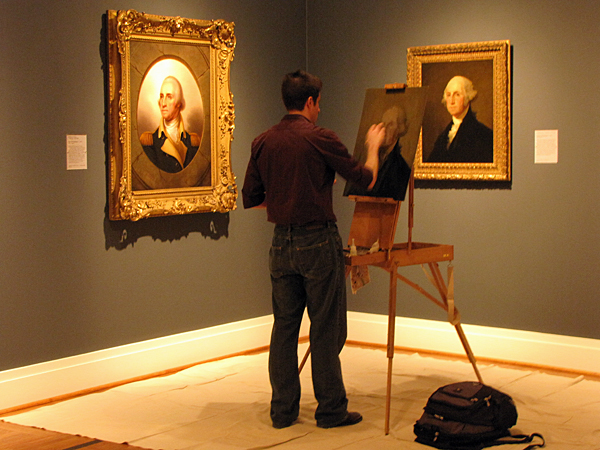
I was going to call this post, “Art for Art’s Sake”, which Anne thought would more truthfully be called “Art for Blog’s Sake”. The museum allows some non-flash photography, so it is an excellent source for blog fodder. Don’t expect to see any great works of art in this post though. The first photo is a house of mirrors treatment of the West Grand Stairs. The second one shows a painter copying a Gilbert Stuart portrait of George Washington, which Stuart made a living out of copying too. I asked him what he was doing, thinking that he might be some sort of museum demonstration. It turned out that he is a student, taking a painting class at the museum. He also had his own personal art guard, just to ensure that no untoward mustaches appeared.

The Painter

One exhibit that could not be photographed was a movie called “Single Wide”. This short film shows a young woman, a pickup truck and a trailer home. The following paragraph is from the museum’s description of the film.

Teresa Hubbard and Alexander Birchler’s film Single Wide, the upcoming New Media Series installation, presents a gripping, though deliberately enigmatic, six-minute story. Shot on a meticulously staged set, the film offers a glimpse into the tormented life of a young woman living in a trailer home. Hubbard and Birchler’s production purposefully offers its audience a highly constructed setting in which detail and ambiguity is skillfully juxtaposed. The film’s intensity and brief yet seamlessly looping story entice viewers to watch Single Wide endlessly – identifying more clues with each pass, but coming no nearer to resolution.

The movie does loop seamlessly, both in time and space. In time, the movie is played as a continuous loop. I ended up watching it several times, before fully realizing this. It also loops in space. The camera is continuously circling the woman, the truck and the single wide. This dual looping effect makes this short movie a compelling film, yet one that poses more questions than it answers.

Squirrelly Art

Sharon, Dan and Annie at the Museum of Jurassic Technology

We called Dan on Saturday. We hadn’t heard from him for a while, and the only Facebook post that I saw all week, had to do with working long hours with power saws. Cue the concerned parents. He is working on his thesis project at CalArts. He is somewhat guarded about it. Probably because he doesn’t want to read about it, on this blog, before it is unveiled. Whoops! I do know that it is big. He has the largest space on campus scheduled. It is also tiny. He has made hundreds of miniature squirrels. They are made out of Green Stuff, a malleable epoxy that dries hard and green. He is in the mist of painting them now. He being Dan, Annie and anyone else he can find to help. I’ve offered to help too.

The photo shows Sharon, Dan and Annie. Sharon is Annie’s friend, from Saint Louis. It was taken at the Museum of Jurassic Technology, which is located in Culver City. Reading the Wiki article, the museum seems to have a rather eclectic collection of novelties, including a display of mice on toast and a mouse pie, they are purported cures for bed-wetting, incontinence and stuttering. The Museum’s founder, David Wilson, received a MacArthur grant, so there must be something to his work. Right?

Dave is in California now, too. He is in San Diego. He is attending the mid-winter meeting of the Association for Research in Otolaryngology. Otolaryngology or ENT (ear, nose and throat) is the branch of medicine and surgery that specializes in the diagnosis and treatment of ear, nose, throat, and head and neck disorders.

It is tax season here in the Lou. Anne has already waded through Dave’s returns, with its taxable energy credits (don’t ask), and has started on Dan’s. And yes, in case you were wondering, she is still preparing the taxes for her two, grown, college educated sons. She also still prepares mine too, and I’m old enough to be their father. So, I’ll leave the all high and mighty role to her. TurboTax, as part of filing Dan’s California state tax return, asked if he was qualified for an Ottoman Turkish Empire Settlement payment. Umm, is there a story here? As it turns out, this is for the benefit of victims (and descendants) of the Armenian Genocide, who settled in California. They recently won an insurance suit.

This post, which revolves about the whole SoCal scene, is somewhat apropos, what with tonight being Oscar night. I have seen even fewer of this year’s nominations than normal. You can blame streaming video for that. Via this technology, I’ve seen more movies this year then normal, just not this year’s nominees. The release lag is still too long. Hopefully, in the not too distant future, this will change. Then, I’ll have more of a stake in the Oscars. More than waiting for a faux pas. I might actually care who wins.

The Also Rans

I was rummaging through old photos on the laptop, when I found the directory that I was working in, when for last Christmas, I made this year’s calendar. There were a lot of other photographs there that had not made the cut. Some of them didn’t make the cut, because they were not the right shape. The requirements of the calendar were for photographs that were four-by-three and not three-by-four. Some didn’t make it, because there were already too many similar photos in the mix, like too many bird pictures, or too many pictures of Anne (In Anne’s opinion). Finally, some didn’t make it, because there were better pictures to choose from, but they were still good photos, at least in my humble opinion. To this end, I give you last year’s also rans.