
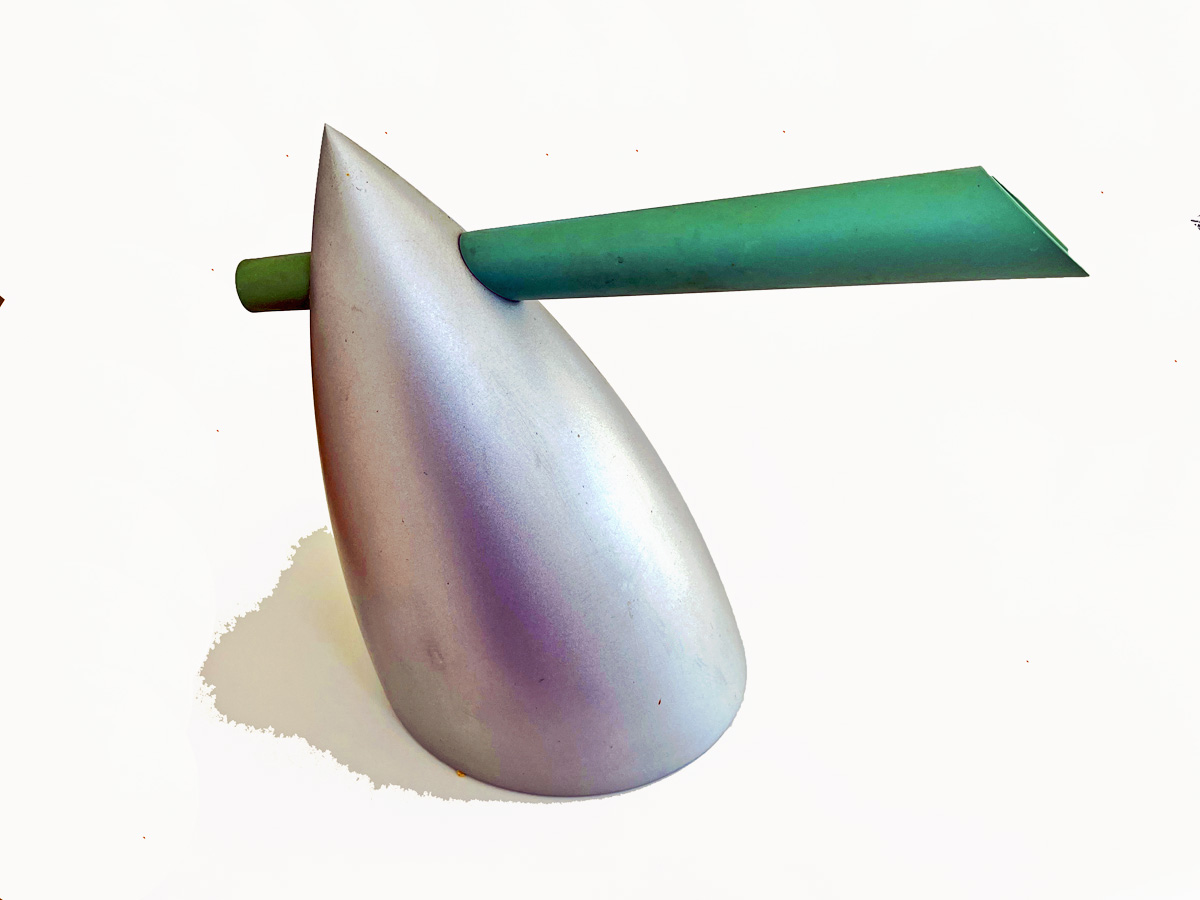

Philippe Starck’s teakettle
The Enigma of 1991 – Although it made its debut in 1991, Philippe Starck’s teakettle represents an apotheosis of 80’s design. It’s expensive, hard to handle and calls attention to itself in an unseemly way. Which is why it seems like a weird curio, not a highly prized domestic totem, in 1992, when the Zeitgeist is tilting toward frugality, function and quiet simplicity. The $250 teakettle, made by Alessi in menacing black or California-mod aqua and silver, looks like an interpretation of a Viking helmet. Resting on a burner in the kitchen, it has an almost dangerous air. It makes you nervous to be in the room with it; you’re afraid it’s going to hurt you. Making tea with it confirms that impression: even after reading the lengthy instructions provided in Italian and English, the novice approaches the task of boiling water with trepidation. The whole thing is difficult to wedge into a small sink; water goes in the large hole in an unsettling way (you expect it to come sloshing back out), and to pour the boiled water from the small hole, extreme wrist strength is required to angle it backward beyond the perpendicular. “It hasn’t been a runaway seller, like the Starck toothbrush or the juicer,” said David Shearer, the manager of Modern Age in Manhattan. “Most people think it’s a light fixture. And the price is a problem for the ones who do realize it’s a teakettle.” If boiling water is the goal, Farberware may be a better idea. But the Starck kettle does provide entertainment, at least for the personnel at the stores that stock it. “People look at it, walk around it, pick it up and turn it sideways and upside down,” said Steve Freedman, the manager of By Design in Los Angeles. “It sells fairly well, considering that nine and a half out of 10 customers can’t figure out what it is. Although a lot of them do say that for $250 it should whistle.” LIZ LOGAN