Jill Bolte Taylor’s Stroke of Insight

TED stands for Technology, Entertainment, Design. TED Talks are 15 to 20 minute standup slide show presentations, in front of a live audience. These genius talks once commanded a small, but highly influential audience. At $2K a seat, the 99% was not admitted. They still command the same live audience, but through the internet, the rest of us can hear these speeches too. Held live in Monterey, really Pacific Grove, just up the beach from Asilomar, TED has posted over a thousand online talks. Notables like Bill Clinton, Al Gore and Steve Jobs have all given TED Talks, but Jill Bolte Taylor’s is the one that I would like to share.

Dr. Jill Bolte Taylor is a neuroanatomist brain scientist who specializes in the postmortem investigation of the human brain. She is affiliated with Indiana University and is the spokesperson for the Harvard Brain Tissue Resource Center. Her own personal experience with a massive stroke, in 1996 at age 37, and her subsequent eight-year recovery, has informed her work as a scientist and speaker. Her experience and this episode is the subject of her TED Talk.

To say that her speech is moving is an understatement. It was once said that everyone has a book in them. Maybe the new rubric is that everyone has a Ted Talk in them. Andy Warhol once said that everyone had just 15 minutes of fame. Who knew it came with PowerPoint slides.

A Tale of Two Cities (with Students!)

This is a guest post by Anne, my muse, she writes the following: So my musee thinks that I should write a blog entry for him. The muse is not amused, but here goes.

Last Saturday, Le Marquis was fighting off a virus, and didn’t feel like going to the High School play, “A Raisin in the Sun”. He missed a good show! I had read the play back in the day, when I was a high school student, but seeing it live was much better. The students did a great job, and I didn’t detect any muffed lines or technical difficulties. It’s always fun for me to see the student thespians, as sometimes the characters they play are so different from their own personalities. In addition, some of the actors are very shy and reserved in real life, so it is even more rewarding to see them on stage. I know I didn’t have that kind of courage to even try out when I was that age. Bravo!

[I heard on NPR this week about a sequel to “Raisin”, called “Clybourn Park”. In this two act play, the first act is set immediately after the conclusion of “Raisin”. The black family has moved the white neighborhood of Clybourn Park. This act deals with the problems that they encountered while integrating. The second act is set fifty years later. Clybourn Park is now a rundown neighborhood. A white couple has just purchased the house. They encounter pushback from the all black neighborhood that is fighting gentrification.]

Wednesday, Joanie and I joined the Science Book Club on the yellow school bus. We rode to Springfield, Illinois to see Rebecca Skloot, author of “The Immortal Life of Henrietta Lacks”. Henrietta Lacks was a poor, black woman who died of cervical cancer in 1951. A sample of her cancer cells was taken without her knowledge. This sample became the first human line of immortal cells, and paved the way for many breakthroughs, including the polio vaccine. The book is a very good book, and the students were excited to meet the author. Ms. Skloot interspersed her talk with passages from the book. She also updated us on the status of the Lacks family and the foundation set up to help them. After the talk, she answered questions from the audience. Then there was a book signing in the lobby of the auditorium. She graciously agreed to pose for a picture with our group after she had signed all the books. We will have a dinner discussion next Wednesday at the high school. I’m interested to see the students’ reactions. I dozed a bit on the way home, and it was far too noisy to hold a real discussion.

Where’s My Nobel Prize?

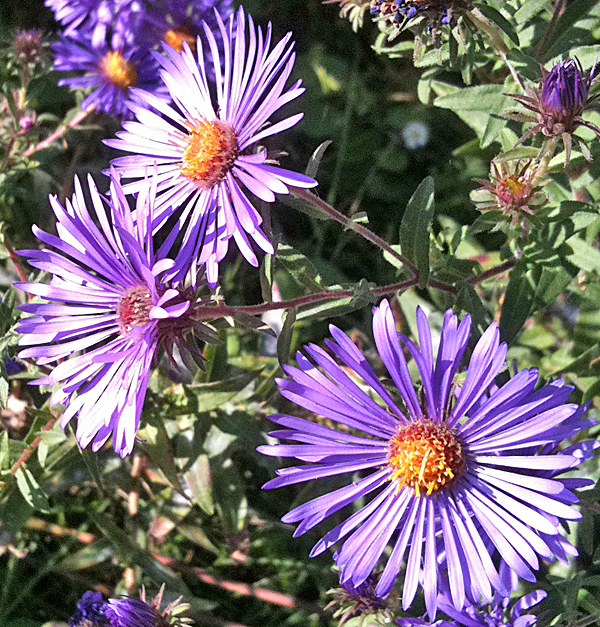
Anne's Aster Alpinus

Anne's Aster Alpinus

The first “test tube” baby, Louise Brown, is now 32 years old and has had children of her own, albeit using an old fashion method that employed simple tools that were found around the house.      

On Monday, Robert Edwards won this year’s Nobel Prize in medicine, for his work that pioneered in vitro fertilization.  His partner in discovery, Patrick Steptoe, was not eligible for this year’s Nobel, because he had already died.  The Nobel committee rightly dictates that prizes may only be awarded to living recipients; otherwise the dead of history would easily crowd out the living.     

Edwards’ work has led to the birth of four million children and counting, to parents that might not have been able to have children of their own otherwise.  Edwards’ work is not without controversy now and certainly was not then.  Not five years before Ms. Brown’s birth, I read Aldous Huxley’s Brave New World for the first time in college.  This 1931 novel spun an apocalyptic tale of test tube born humanity, where children were more hatched than born.    

Five year’s after Ms. Brown’s birth I found myself at MIT in Boston, more specifically at the Whitehead Institute for Biomedical Research.  This division of MIT was endowed by a business man, Jack Whitehead, and at the time that I was there, was headed by the Nobel laureate David Baltimore.  Baltimore won his prize for discoveries concerning the interaction between tumor viruses and the genetic material of the cell.     

On the record, when I was in Boston, I never met nor even heard about NPR’s Car Guy’s, more the pity though for missing them when I had the opportunity to meet them, even in Harvard Square.    

The normal CDC mainframe, the Cyber, was designed in the 1960s by Seymour Cray.  It employed a 60 bit word, not 64 bit mind you, but just 60, just large enough to win the government contract that launched the series.  I first was introduced to this machine in 1972 when I attended Michigan State.  MSU had a single digit serial number machine.  A degree later, I was working at CDC.    

The Cyber Plus employed a normal 60 bit mainframe as its front end, but added a 512 bit backend.  This enormous word size was the selling point.  Boston’s hometown Digital VAX computers only had 32 bits.  If you are a geneticist and are looking at sequencing millions of genes, speed matters and the Cyber Plus looked like the ticket to that speed.  Except that it wasn’t.  It had been designed and specially built for its original purpose, cryptology, and was not easily mutable to other uses.    

I worked that summer to make the Cyber Plus a gene splicing engine, but computer architecture was working against me.  My work did not go unnoticed by the customer though.  My customer, the manager of the Whitehead computer center, reported to Baltimore.  He was ambitious too.     

He told me on more than one occasion that he wanted his Nobel too.  He felt that he had an advantage over his colleges.  He was trying to do with computers, what his Nobel competitors were still trying to do in the lab.  He was especially interested in the visualization of his work; pictures sell so much better than words.  

As a parting shot, I clued him into the Silicon Graphics workstations that we were just starting to sell.  I think that I offered him fair value for my services with that one steer.  The Cyber Plus ship was defiantly on its way down to the bottom.  He has not won any Nobel prizes as of yet, but he was young then and could still win one yet.  He is still eligible, he is still alive.

Scientia

From wiki:

Science (from the Latin scientia, meaning “knowledge” or “knowing”) is the effort to discover, and increase human understanding of how the physical world works. 

This definition seems somewhat altruistic, since science can also be spectacle and/or entertainment.  Exhibit one is also known as Spaceship One.  A replica, at the St. Louis Science Center is pictured above.  It was the wining vehicle of the Ansari X Prize.  This X prize was a space competition in which the X Prize Foundation offered $10M to the first group to launch the same manned spacecraft into space twice.  It was modeled after early 20th-century aviation prizes, such as the one Charles Lindbergh won by flying the Spirit of St. Louis.  It is this relationship that caused the X Prize Foundation to award this prize in 2004, in St. Louis.

The success of this first X Prize has spawn more contests.  There is now one for genomics, where you must sequence a 100 human genomes within 10 days.  There is an automotive one where you must build a commercially viable car design that gets 100 MPG.  And there is Google’s lunar challenge, where you must operate a rover on the moon.  All of these scientific stunts demonstrate capability, increase efficiency and offer lower costs.  For the money invested, how much more will we know?

Then there is science as pure entertainment.  The St. Louis Science Center is exhibit two, as pictured above.  Like most science centers that I’ve been to it is a child’s proscription for ADD.  When it is empty it is quiet, but does no one any good.  When it is full it is loud and chaotic.  It offers one distraction from another.

The Smithsonian does science better then most, but on a recent trip to DC, I found the Air and Space museum better, only because it had the originals and not just replicas.  Long ago, in junior high, I lived in Washington.  My mom use to truck my brother and I down to the Smithsonian on Saturday mornings to attend classes there.  We took classes in astronomy, archeology, paleontology and more.  These were lectures by senior (at least in years) staff members.  Some of the classes also offered tours behind the scenes.  These tours where the lecturer handled exhibit material with care and casualness stays with me today.

So how do we discover knowledge of the the physical world?  How do we do science?  With scientists, that’s how.  Real science is done only by scientists.  Spectacle and entertainment are great for exciting the interest of the public and for attracting young minds, but we need to close the deal, we need tomorrow’s scientists.  Today’s scientists need to recruit their replacements.  Today’s scientists need to lead by example.