
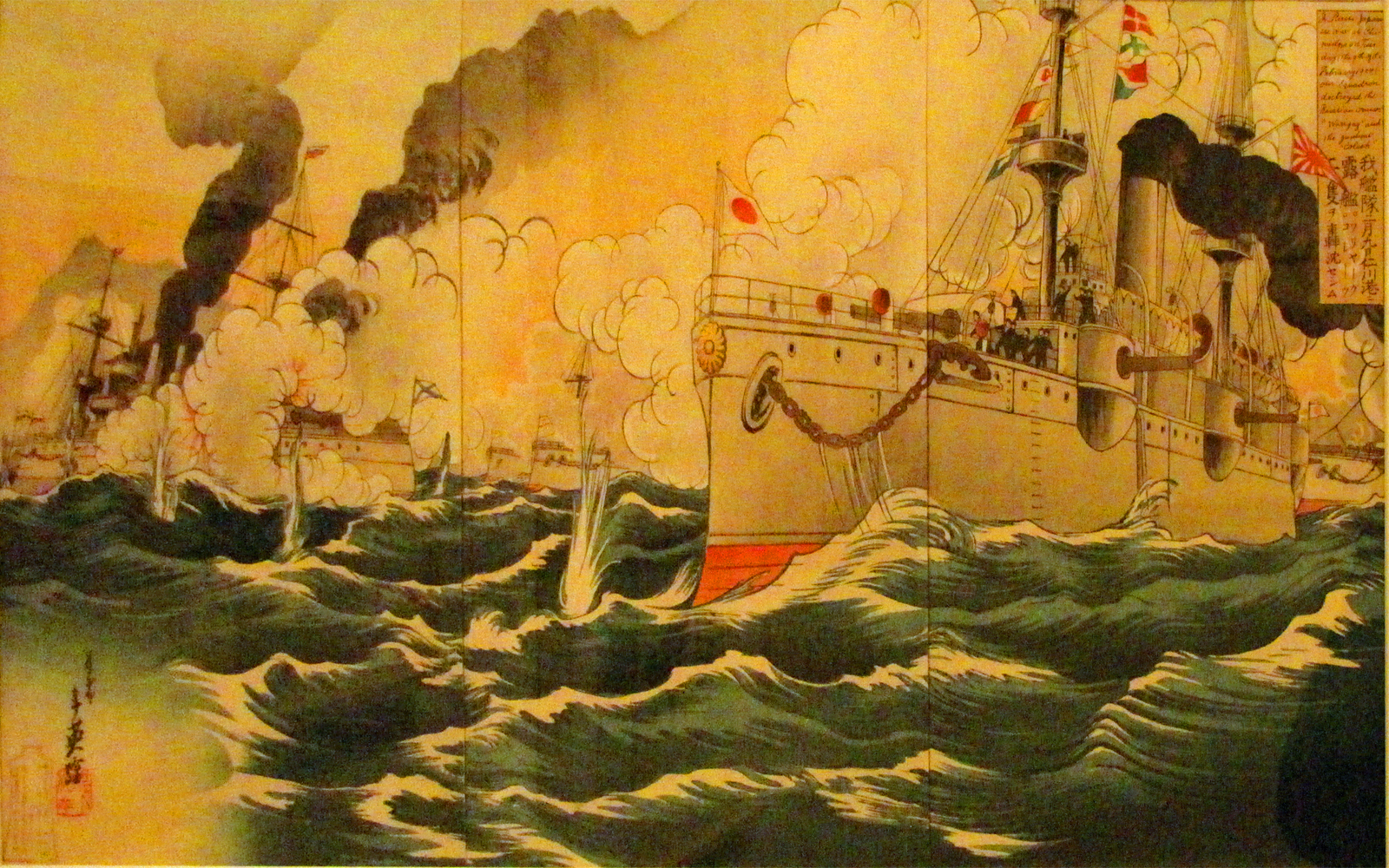

Big Victory: Our Fleet Sank Two Russian Ships, the Varyag and Korietz Respectively, on February 9, 1904, at the Port of Jinsen, Migita Toshihide
Glimpsing History Through Art:
Selections from the Charles and Rosalyn
Lowenhaupt Collection of Japanese Prints
The Sino-Japanese War (1894-1895) and the Russo-Japanese War (1904-1905) provided new subject matter for Japanese woodblock artists of the late 19th and early 20th centuries. Woodblock artists who had watched demand for their work decline due to the availability of newer visual mediums such as lithography and photography found a way to entice customers with inexpensive yet colorful prints.
At the beginning of the Meiji period (1868-1912), political power was stripped from the military ruler (shogun) and restored to the emperor, who set Japan on an ambitious path toward modernity. Having modeled its army and navy on the West, Japan took on an increasingly imperialistic agenda as it emerged victorious in the wars against China and Russia. Color woodblock prints depicting scenes of the wars were mostly produced in Tokyo. Astonishingly, many were designed, printed, and issued only days after actual military events occurred. At one level they served to disseminate news of the wars to interested members of the Japanese
public on the home front, but they were also propaganda tools designed to elicit support for the war efforts.
Since 1988, Charles and Rosalyn Lowenhaupt of St. Louis have collected Japanese art, focusing on prints of the two wars. Starting in 2004, they presented several prints from their collection to the Saint Louis Art Museum. In September 2010, the Lowenhaupts donated an additional 1,357 works (including 1,296 prints) to the Museum. This generous gift makes the Museum a premier center for the study of art produced during this pivotal period in Japan’s modern history.